Thursday, June 30, 2005

For-profit charters in a dither over losing federal funds

For-profit charter owners/operators in Arizona are set to lose $3.6 million in federal special ed and Title I funding, according to this Arizona Republic article. A quick search of ed.gov found, buried in this August 24, 2004 document, that the schools aren't really "losing" the funds (as the editorial lambasted in this shutupandteach post suggests), they just were never supposed to receive them in the first place:
Under Arizona State law, charter school LEAs may be private or public entities. However, under applicable Federal laws and regulations, only public entities may receive Title I and IDEA funds.
Now this has me confused for several reasons:
  1. Are no for-profit schools, anywhere in the country, supposed to be receiving Title I and IDEA funds? And are they receiving them anyway?
  2. What is the logic behind cracking down on this funding? Isn't it going to further encourage for-profits to "counsel out" costly special ed students, who could eat into profits?

Did Bush's proposals fuel illegal immigration?

That's what this article in today's Washington Post asks. Judical Watch, a conservative group, argues that, based on surveys conducted by the Border Patrol, that many undocumented immigrants attempting to cross the Mexico-U.S. border were doing so because they believed Bush was offering amnesty (he had offered some very vague proposals about a guestworker program where undocumented immigrants already in the U.S. could receive temporary legal status).

This uninformed suggestion is belied by a recent study from Douglass Massey (released by the CATO Institute, a libertarian think-tank), which shows U.S. immigration policy since NAFTA has actually increased the flow of undocumented immigrants by pursuing economic integration with Mexico while prohibiting the free movement of labor. Massey also argues stepped-up border enforcement not only has not discouraged undocumented immigrants from emigrating to the U.S., but it caused many immigrants to stay in the U.S. longer than they would have because of the difficulties in crossing the border. This argument, which makes perfect sense, should be heeded by those who base their support for more border enforcement on how much it costs taxpayers (incidentally, most immigrants pay taxes also, but I won't get in to that debate right now) to pay for public services used by immigrants and their families.

Blaming amnesty proposals for an increase in "illegal" immigration (Bush did not propose amnesty, nor have any of the other immigration reform bills, particularly the McCain-Kennedy bill) is a common argument by anti-immigrant groups. A much more important cause of undocumented immigration is the large number of jobs requiring cheap labor in the United States.

Wednesday, June 29, 2005

bring on the evaluators

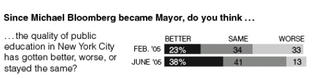
i agree with chris that having an independent review of the test scores is a good idea. if learning really has improved due to hard work, and the gains are not the result of an easier test, more children exempted, or any of the various reasons given by bloomberg's political opponents, then it can only be good for both bloomie and the city.

and as this poll from the NYT found, he's not doing so bad. apparently,
Asked how much credit he deserved for rising test scores in the schools, 66 percent said "a lot" or "some." Mr. Bloomberg has said that voters should judge him principally on education.


(graphic made possible by a new feature on blogger! thanks blogger!)

The DREAM Act

Eduwonk is right on about a Washington Post story about a Missouri girl originally from Costa Rica that is danger of being deported but could have been saved by the DREAM Act (the Act would overturn a 1996 provision that prohibits state universities from offering in-state tuition to undocumented immigrants, and, important especially in cases like these, would allow undocumented students that complete college to become legal residents).

It is outragous, as Eduwonk says, that the DREAM Act hasn't passed Congress despite Bush's interest in and understanding of immigration. In the days before Sept. 11, as depressed as I was about Bush's "victory," I really thought he would be able to deliver sensible immigration reform. I don't know why he hasn't supported any number of good immigration bills that have come up since 9/11 (including AgJobs, the recently introduced McCain-Kennedy bill and of course the DREAM Act) or pushed for his own pro-business guest worker program (which would be better than the status quo). It's probably a combination of the strength of the anti-immigration lobby (not all Republicans - even conservatives like Orin Hatch support the DREAM Act), Bush's unwillingness to spend political capital on anything that isn't an issue for social conservatives (besides the war) and the fact that immigrant issues just aren't being seen as pressing on a national level.

As I have said before, I think the state-by-state movement to allow undocumented immigrants to pay in-state tuition shows that pressue for change is building. Supporting immigrant kids that want to go to college should be a no-brainer, not matter what your views on undocumented immigrants are. Not that MO Senators Bond and Talent will ever get it.

For those of you in New York City with a little time on your hands now that school has ended, there is a rally in support of the DREAM Act in Thomas Paine Park this Thursday (June 30th). The park is on the corner of Worth and Lafayette (N, R, W or 6 to Canal St, or C, 4, 5, 6, J, M, Z, 2, 3 to Broadway-Nassau)

Cap update

according to an e-bulletin by the New York Charter School Association, all is not lost for lifting the cap on charter schools in NY:
While an agreement was not reached as the session ended, the discussions at the Capitol have provided the charter school movement with a tremendous boost. The Legislature may reconvene later this year to continue work on some issues left unresolved —such as the charter school cap.
and as the Albany Times Union reported about the cap lift, "... such a law would be high on the to-do lists of lawmakers next year, especially for those representing largely black and Hispanic districts."

School's over, but the debate about test scores isn't

Several articles today look at the debate over what New York City's recent test score increases mean. In this NYT article, Councilwoman Eva Moskowitz (head of the education committee) questions Bloomberg's assertion that higher test scores represent greater student achievement and continues to call for more information to be released so the reliably of these scores can be analyzed. In response to this criticism, Klein is thinking about creating an independent panal to evaluate student performance (similar to Chicago's), reports the Daily News. Finally, this Newsday article has Schools Chancellor Klein sounding optimistic about next year even as Moskowitz hammers away about low morale throughout the school system.

I think having this debate is good for NYC schools, and I'm glad the City Council isn't taking Bloomberg and Klein on their word that one year of rising test scores means that real progress is being made towards fixing city public schools.

Tuesday, June 28, 2005

Getting immigrant parents involved

This op-ed in Newsday by Andrew Friedman of the DRUM Major Institute makes a lot of good points about the importance of providing translation services for immigrant parents. Although I think he is right to argue that NYC politicians have an obligation to support legislation that will help immigrants access services, the main point should be that increasing parent participation in schools (in a city where 25 percent of adults do not speak English) is too important to leave to squabbling over how quickly immigrants should be learning English (even though he correctly says that immigrants are trying to learn English but most classes in NYC are full).
This quote shows why the City Council (and Bloomberg) need to make sure that translation is being provided for immigrant parents at parent-teacher conferences, PTA meetings and any other time they come to their children's school:

According to Linda Hodges, president of the national Parent Teacher Association, "When parents are involved, children have higher grades and test scores, better attendance, increased motivation, better self-esteem, higher graduation rates and a greater likelihood of pursuing a postsecondary education."

It's amazing that Bloomberg isn't backing the Education Equity Act, which would require the DOE to translate for parents and provide translated school documents, when Schools Chancellor Klein has said things like this: "We know that when parents get involved, schools improve and our children benefit." Part of me thinks that despite the mayor's well-publicized ad campaign in Spanish, immigrant concerns still aren't being taken seriously in this city. How else can you explain Bloomberg and Miller's tepid response to a relatively inexpensive initiative that would almost certainly improve schools (and probably test scores), even as both candidates continue to harp on education issues?

john walton killed in plane crash

billionaire wal-mart heir john walton died yesterday in a plane crash. this really is horrible and i feel bad for all the negative things i've said and thought about the guy, who heads up the Walton Family Foundation's efforts to fuel the voucher movement. (the WFF gives money to many other good things as well, including one of the charter schools with whom i work.)

Monday, June 27, 2005

A cap even brute force could not remove

according to this Newsday editorial, pataki did not succeed in lifting the charter school cap before the legislative session ended last week.

Saturday, June 25, 2005

Educating Girls

The New York Times has a really interesting editorial today about the benefits of educating girls, particularly in the developing world. They cite a report by Save the Children that has some pretty amazing findings. Among them is this one:

“The more time girls spend in school, the better their chances of breaking the cycle of poverty and becoming mothers who raise healthier children and send their own children to school – girls and boys,” said O’Gara. “Investing in girls’ education also leads to increases in income, both for individuals and for nations as a whole, over several generations.”

Save the Children says that 58 million primary-school age girls worldwide are not in school, but that some poor countries are making dramatic gains, including Bolivia. In the rural communities I visited there, women were much more likely than men to be illiterate and mono-lingual Quechua (an indigenous language prevalent throughout much of the central highland valleys) speakers, meaning many never even went to primary school, which until recently conducted classes only in Spanish. It seems like the introduction of bilingual education programs (Quechua-Spanish, Aymara-Spanish, etc) - along with some other education reforms - has encouraged more parents to send their girls to school (completion of primary school has risen from 10 percent to 78 percent). Although Bolivia seems to be jumping from one crisis to another these days, this is really encouraging news.

More controversy over test scores

Newsday reports today that New York State Regents math tests will be rescored because the exam was deemed to be too difficult. Apparently a much higher percentage of high school students failed the exam than in previous years, leading the state Dept. of Education to issue a "conversion chart" for the scores. But the article also mentions a high volume of complaints from parents had something to do with the decision. It will be interesting to see the details of where these complaints came from and whether the income level of the parents had anything to do with the decision. A parent and the superintendent from Harborfields, NY (Long Island) are quoted in the article - and I see that the high school there has some pretty striking differences from the average NY public school - a much higher percentage of white students (84% to 58%), a much lower percentage of students on free lunch (3% compared with 26%) and a pretty high median income level in the district ($69,657 to $43,515).

Friday, June 24, 2005

Runglish

Here is an interesting article on the mix of English and Russian spoken by Russian immigrants in New York and beyond. Apparently some people estimate that 130 million people speak Runglish (although the author of the article disputes the claim), which consists of a combination of Russian grammar and pronunciation with English words. Like with Spanglish, there is a debate on the merits of immigrants straddling the line between English and their native language. It is interesting that the Tower of Babel is mentioned - I happened to come across an anti-immigrant blog the other day and many of the negative reactions to a New York City Council bill calling for city business to be translated into other languages pointed to the Tower of Babel as a reason for forcing immigrants to speak English (as did the New York Sun in this tolerant piece that claimed that most people in New York that speak Spanish are not citizens). As with many of the arguments from the anti-immigrant wing, I think many English-language-only proponents are motivated by fear of the unknown. As this article and Ilan Stavan's wonderful book "Spanglish: The Making of a New American Language" argue, languages (even English) are dynamic and are constantly borrowing from other languages and cultures. Speaking English will always be important for immigrants in this country to get ahead and won't cease to be no matter how many immigrants arrive because their kids are learning English (and, as I have argued in previous posts, they are doing their best to learn), but the fact that "languages" like Spanglish and Runglish are thriving shows how xenophobes may be losing the battle.

Moderation in politics

This has nothing to do with education in New York City, but I feel compelled to comment on some recent events in the Andes. Jon Stewart is doing a great series over at the Daily Show on toning down the political rhetoric in this country. But I wonder what he would say about the current events in Ecuador, where prisoners have been crucifying themselves in protest of overcrowded jails. And this isn't good news:

"Today there have been crucifixions. Tomorrow there will be something worse," a prisoner told the Reuters news agency.

I'm quite sure the conditions in Ecuadorian prisons are terrible, but crucifixion as a means of protest has always bothered me (it happens more than you think in Latin America). Once protests go that far, there isn't any room to step back and the conflicts tend to intensify.
But in Bolivia, which is experiencing similar popular upheavals, moderation just might have a chance. In big news, Evo Morales (the leader of MAS - a leftist political party with a base among coca growers) is working on forming an anti-neoliberal alliance with an emerging center-left political movement based in La Paz. Politics are really polarized in Bolivia, and this an important development with general elections coming up later this year. Of course, Evo Morales as president is the Bush administration's worst nightmare.

Thursday, June 23, 2005

Where's the accountability for special education?

Another report, this time from a federal audit, slams the special education system in New York. The audit's findings, reported on in this article in the New York Times, describe the record-keeping system that used Medicaid funds to give poor special ed kids speech therapy as "chaotic" and charge that city schools misspent $870 million "by channeling tens of thousands of poor special-education students into speech therapy performed by unqualified practitioners, often without proper referrals."

City and state officials are saying that the audit is being unfair and that federal regulations are confusing, but this latest report underscores a major problem of the New York City special education system - the lack of accountability. The audit even mentions that many parents still complained about receiving services despite all the improper spending. It is unacceptable that poor special education students are getting speech services from unqualified therapists, and it is unacceptable that only 12 percent all special ed students are graduating from high school.

Doggone liberals thwart Santorum's plans again

the Santorum family may end up having to pay tuition to homeschool their kids if a bill passes in the PA senate requiring cyber-charter school students to live in-state to receive a free education.

UFT charter holds lottery

as reported in today's NY Daily News, the United Federation of Teachers Elementary Charter School held its admissions lottery last night. it will open for grades K and 1 in september. 400 parents submitted their kids' names for 150 slots. exciting!

charter school politicking -- pataki to lift the cap?

according to the NY Sun, Pataki is currently engaged in an aggressive last-minute push to raise the cap on charter schools in the state from 100 to 200 schools. rumors of his backroom methods for getting what he wants range from carrots ---
Mr. Pataki convinced lawmakers to allow charter schools in New York seven years ago, in exchange for a legislative pay raise. There was some speculation yesterday that another pay hike would be offered in exchange for raising the cap, but aides to the governor said such a deal was not on the table as of late in the day.
to sticks --
But people close to the talks, speaking on condition they would not be identified, said the governor has threatened that unless changes to the charter school law are made, he will veto bills that direct money to upstate school districts, a number of which passed in the Assembly this week.
the legislative session ends this week. i'll keep you posted on any cap movement.

Wednesday, June 22, 2005

Dropout Crisis for ELLs

An article in today's Education Week looks at the recent trend for states to enact tougher graduation requirements for high schools. While I (and most Americans, according to this survey, also from Education Week) believe that a lot of graduating high school seniors are not ready for college and should be challenged and expected to meet higher standards that will increase their chances of succeeding, I'm still not convinced it is a great idea to set strict graduation requirements when students have so many different needs. Take English Language Learners (ELLs) in New York City, for example. According to a press release yesterday by the New York Immigration Coalition, over half of ELLs (many of which are newly arrived immigrant students) in the class of 2001 failed to graduate in 7 years and dropped out of school (shown in a recent study by the city Department of Education). In the face of this crisis, the State Board of Regents will be increasing the passing score for high school students to 65 in 2008. ELLs (while more likely than other students to fail) that actually do pass the Regents tend to score in the range of 55-64, which currently allows them to meet the requirement for the low-pass option and receive a local diploma.

Asking for a little flexibility for ELLs (like establishing an alternative English proficiency test for late arriving immigrant students to be able to graduate) to me isn't a question of watering down standards and lowering expectations - it's about recognizing reality and trying to help kids that really need it. According to Margie McHugh, the director of the New York Immigration Coalition, "When ELLs get the help they need and become proficient in English they have the highest graduation rates and lowest dropout rates of all students in New York City—we know that ELLs can succeed if they get a quality education and have a fair chance at meeting appropriate standards.” The gap between proficient and non-proficient ELLs clearly shows that city public schools are not meeting the needs of a lot of ELL and immigrant students, but instead of focusing on the problem (like putting more resources into ESL and bilingual teaching), the state's actions will cause more students to fail and drop out, which hurts their chances at eventually finding good jobs. Schools need to make sure that students are challenged and better prepared for life after high school, but not at the expense of populations like ELLs that need more help and a little flexibility in order to succeed.

post to come ..

.. on the recent changes in graduation requirements in NY State. meanwhile, for more info on the changes, check here, here, and here. (editorial here.)

(also, for more information on the giant popsicle that melted in Union Square yesterday, go here.)

Tuesday, June 21, 2005

it's all about relationships

zweichenzug over at The Bellman wrote a very thought provoking post about the grad student unionization issue, the main point (to me anyway) of which was that it's dangerous to talk about grad students as being different from, say, migrant farm workers, because they are "knowledge workers" and not laborers, because doing so ignores the fact that their work is being commodified just as much as the pickers'. it's also a class thing. i am guilty of doing this myself and need to think about it some more.

in the meantime, while i think about that, here's an excerpt from an email i got from Jacob Lew, Executive Vice President of NYU, and David McLaughlin, Provost (can't find the full text online -- i'll put up a link once i do):
At the same time, many members of our community have expressed deep reservations about the impact of the collective bargaining framework on our academic programs. These reservations include the difficulty of reconciling a non-academic intermediary between faculty mentor and student, and the introduction of the one-size-fits-all approach – traditional in the labor context –into a University that values distinctive scholarship and prides itself on the diversity of its graduate programs.
and here's a statement by Wal-Mart on unions (lifted from this article):
Wal-Mart's statement on unions:
At Wal-Mart, we respect the individual rights of our associates and encourage them to express their ideas, comments and concerns. Because we believe in maintaining an environment of open communications, we do not believe there is a need for third-party representation.