More "Teachers vs. Kids" language in this Buffalo News editorial on the recent movement in the health insurance quandary the Buffalo school district's in with its teachers. (Previous post, with interesting comments, here.)
Also, if you haven't had enough of Buffalo, check out this review of a new book on abortion battles in Buffalo from the most recent The Nation. I know the guy who wrote it! (The review, not the book.)
Friday, March 10, 2006


Wednesday, March 08, 2006
A revelation
Since the School of Bloggers are facing a possible move to Minneapolis, I of course immediately went to look at the charter schools there. Warm-blooded southerner that I am, I was not expecting to find much to like about Minnesota. I was shocked to find out how COOL the charters are there! Look at this one! And this one! There are two charters for the Hmong community and at least two for American Indian students.
Why are charters so cool in Minneapolis? Turns out there's a reason.
Unscrupulous SES companies
Tutoring companies in NYC have engaged in a number of improper activities while trying to enroll poor students in Supplemental Educational Services (SES) programs, according to this NY Times article. I have no idea if some of the more aggressive companies working at my school have done anything like the examples in the article (both Newton Learning and Platform Learning are mentioned specifically in the city's report and are particularly aggressive in going after students and parents), but the atmosphere that these companies create in the school really poisons the whole process. A lot of parents have no idea what is going on and often don't know what they are signing, but they are really pressured by representatives of these companies at parent-teacher conferences and other school events to sign their kids up for SES.
Even though the recruiting efforts were stepped up this year, there hasn't been much difference in the numbers of kids enrolled in SES programs (it is still pathetically low). Most of my kids that signed up for other programs stopped going a long time ago, and it seems like the only ones that are really benefiting already have good tests scores and involved parents. If most parents don't understand the programs they are enrolling their kids in, how can schools expect struggling and disruptive kids to take it upon themselves to show up for tutoring on their own initiative? SES programs, at least at my school, are not serving the kids that need the most help.
I don't know what the solution is since the 37.5 extra minutes a day has been a nightmare so far at my school (more on this in the next post). The problems with SES can't all be blamed on tutoring companies, but I believe that a lot of them do start there.
Tuesday, February 28, 2006
Victory (Kind of) at last for Immigrant Parents
Yesterday, Bloomberg and the City Council agreed to expand translation services to immigrant parents (Newsday article here, and DOE press release on the deal here). The increase in funds ($2 million will be added to the $10 million the city already spends) to Bloomy's Translation and Interpretation Unit will allow more school documents to be translated. The deal sidesteps a threat by the City Council to override Bloomberg's recent veto of the Education Equity Act, which would have mandated more comprehensive translation services in schools.
It will be hard to tell anytime soon if the extra money will change much in the schools and as the Newsday article points out, the provision that says services will be available to "the extent practicable" is worrying because schools may simply choose not provide the services since it often isn't practical for schools without resources to provide translation services to parents in a number of languages. Still, it is encouraging that something was done to reach out to immigrant parents and not treat them as second-class citizens simply because they haven't learned English yet. If these parents can become more involved in their children's education, I think the benefits to schools and communities will outweigh the costs of increased services. Language access doesn't guarantee parent involvement, but it is a good first step.
Friday, February 24, 2006
Update on the Education Equity Act
The Daily News reported on Tuesday that council members may be working on a compromise to increase translation services for immigrant parents in NYC schools. The City Council passed the Education Equity Act late last year, and Bloomy vetoed it, saying the bill would violate state law. Let's hope they come up with something soon - I spent last Thursday translating for dozens of Spanish-speaking parents at parent-teacher conferences in an ESL class, and most of the parents told me or the teacher that it was the first time they had been able to communicate with their children's teacher. Is it any wonder that most of the school's parents didn't bother to show up for the conferences?
Friday, February 17, 2006
Charters and segregation
Meanwhile, in other charter news, a new report has come out about how charter schools do nothing to desegregate schools in Michigan. From the co-director of the study's policy center:
There was another big study by these people a few years ago on the same topic.
My question is, were charter schools ever intended to be forces of racial desegregation? Yes, they should (and do) integrate students economically, but is it such a bad thing if minority parents decide to send their children to schools where the other students look like them?
I keep thinking of an article by Lisa Delpit where she discusses her own daughter's move from a private school in which she is the only black student to a largely black charter school. The effect on her daughter's self esteem was significant, and startling to Delpit. Charter schools are schools of choice -- parents choose to send their children there for any number of reasons. Is that really segregation?
I'm also thinking about the two charter schools I work with -- one had a Latina founding principal, and a large proportion of the faculty and staff there are Latino. At an event last night, graduates of the school greeted many of the parents at the door in Spanish, with kisses on the cheek. Is it any wonder that Latino parents would want to send their children there, and that 60% of the students are Latino?
At the other school, a large proportion of the faculty and staff are black. The school song is an African folk tune, and the school's culture feels distinctly black. Is it any wonder that black parents would want to send their children there, and that 90% of the students are black?
Finally, being a white woman I'm not sure if I should be offended by the idea of the "peer effect" for race. The Harvard Civil Rights Project makes the case that segregation is an evil in itself, but I'm not sure if I buy it, especially in the case of charter schools.
"Parents are moving their students from racially segregated (traditionally public) schools to racially segregated charters."
There was another big study by these people a few years ago on the same topic.
My question is, were charter schools ever intended to be forces of racial desegregation? Yes, they should (and do) integrate students economically, but is it such a bad thing if minority parents decide to send their children to schools where the other students look like them?
I keep thinking of an article by Lisa Delpit where she discusses her own daughter's move from a private school in which she is the only black student to a largely black charter school. The effect on her daughter's self esteem was significant, and startling to Delpit. Charter schools are schools of choice -- parents choose to send their children there for any number of reasons. Is that really segregation?
I'm also thinking about the two charter schools I work with -- one had a Latina founding principal, and a large proportion of the faculty and staff there are Latino. At an event last night, graduates of the school greeted many of the parents at the door in Spanish, with kisses on the cheek. Is it any wonder that Latino parents would want to send their children there, and that 60% of the students are Latino?
At the other school, a large proportion of the faculty and staff are black. The school song is an African folk tune, and the school's culture feels distinctly black. Is it any wonder that black parents would want to send their children there, and that 90% of the students are black?
Finally, being a white woman I'm not sure if I should be offended by the idea of the "peer effect" for race. The Harvard Civil Rights Project makes the case that segregation is an evil in itself, but I'm not sure if I buy it, especially in the case of charter schools.
Touché
Eduwonk's guest blogger this week gets at the one thing that irritates my conscience when I advocate for charter schools.
Tuesday, February 14, 2006
The good book(s)
Bible thumping in my home state. From the Economist:
Meanwhile, in the "Humanities and the Social Studies" course I'm taking right now, we recently did a model lesson on the Old Testament, the New Testament, and the Koran. (Students are required to know something about these books for the Regents.) We used literary analysis techniques to compare excerpts from the three books relating to certain topics (food, women, holy war, etc.). The lesson had its limitations, but it seemed like an interesting way to approach what is required material -- it completely steered clear from theology. (Though, even in my masters' level class of adults, it was not possible for everyone to look at the material objectively.)
The point is, holy texts do have a place in the high school classroom. But do they really need their own elective? Why single out the Old Testament and the New Testament for their own separate electives? This is a purely political bill that is meant to separate the bible-lovers from the god-haters in an election year (see the political scientist's comment).
Bible Study
A bill that would allow for Bible classes in public schools was approved by a 50-1 margin by state senators on February 3rd. Regina Thomas, a Democrat from Savannah, was the lone dissenter. State Republicans had been trying to pass a version of the bill since 2000. The version that passed, sponsored by Tommie Williams, the majority leader, requires the state board of education to approve two new elective high-school courses (which are not required for graduation): one on the Old Testament and one on the New. The bill also requires that the Bible be used as a textbook.
A version of the bill sponsored by three Democratic members would have created only one course and would not have required the use of the Bible, but lack of support forced the sponsors to vote for Mr Williams’s bill. Charles Bullock, a political science professor at the University of Georgia, observed that it was better to be seen “running and hiding in the rest room” than be accused of voting against the Bible. A spokeswoman for the American Civil Liberties Union of Georgia, meanwhile, promised to watch the bill closely.
Meanwhile, in the "Humanities and the Social Studies" course I'm taking right now, we recently did a model lesson on the Old Testament, the New Testament, and the Koran. (Students are required to know something about these books for the Regents.) We used literary analysis techniques to compare excerpts from the three books relating to certain topics (food, women, holy war, etc.). The lesson had its limitations, but it seemed like an interesting way to approach what is required material -- it completely steered clear from theology. (Though, even in my masters' level class of adults, it was not possible for everyone to look at the material objectively.)
The point is, holy texts do have a place in the high school classroom. But do they really need their own elective? Why single out the Old Testament and the New Testament for their own separate electives? This is a purely political bill that is meant to separate the bible-lovers from the god-haters in an election year (see the political scientist's comment).
Thursday, February 09, 2006
My unending quest to find new sources of procrastination
Check out the blogs I have recently added to the sidebar:
Your Mama's Mad Tedious indulges my love of teacher narratives and Chris's obsession with baseball.
A History Teacher is my new eGuru.
Life in the Mobile Learning Cottage is written by a history/literature teacher who shares my fear of other people's vomit.
Tuesday, February 07, 2006
More on the new schedule
I talked to a lot of kids today about the extra tutoring sessions, and almost everyone hated it. I know that it's still being worked out, but too many complained about not doing anything (most were simply given a worksheet after everyone calmed down). A few other kids said that although they needed help in math, the work in the extra sessions was too easy. I originally thought that kids would be embarrassed about being required to attend tutoring, but it seems that because so many kids have to stay (I have about 5 students out of the 40 in after-school that don't have tutoring) it shouldn't be much of a problem. But it doesn't seem like the sessions are going to be an efficient way to help struggling kids.
According to this poll from Insideschools.org, parents are not happy with the new schedule either. A major problem seems to be that parents aren't getting enough information about what is going on. It doesn't seem like my school has done a good job informing parents, but it is also crazy to expect schools to successfully implement something this big in the middle of the year. Why not wait until next fall?
37.5 minutes of chaos
Yesterday the extended tutoring schedule went into effect and it was crazy at my middle school (it seems like it was a similar situation elsewhere, according to this NY Times article). Dozens of parents were calling the after-school office trying to figure out where their kids were, and it seemed like a number of students that were supposed to be in tutoring left the building early (I can usually tell by how many kids have McDonalds). Nobody at the school seemed to know what was going on. And the kids that went to tutoring were absolutely off the wall in after-school. I really hope this works itself out, but I'm not optimistic after yesterday.
Monday, February 06, 2006

Monday, January 30, 2006
Musical Chairs
Not sure how I missed this, but the new chairman of the New York City Council's education committee is Robert Jackson. (I read it in this article.) I don't know much about him, but he appears to be quite a departure from his predecessor, Eva Moskowitz.
Friday, January 27, 2006
Thinking globally
In one of my social studies ed classes our first assignment of the semester was to take the August 2004 Global Studies Regents exam. My performance on that test was, shall we say, embarrassing to me and frightening to you whose children I'm going to teach someday.
Questions that stumped me:
7) Some historians suggest that as a result of the Mongol invasions of Russia, the Russian people were
(1) united with the Ottomans
(2) converted to Christianity
(3) freed from serfdom
(4) cut off from most of western Europe
22) One result of the Opium War was that China
(1) adopted democratic reforms
(2) gained control of Hong Kong
(3) regained control of Manchuria
(4) was divided into spheres of influence
Questions that I thought were really good questions:
39) The caste system in India and the feudal system in Europe were similar in that both
(1) provided structure for society
(2) developed concepts of natural rights
(3) established totalitarian governments
(4) promoted peace and prosperity
44) Which statement best describes an impact of the computer on the global economy?
(1) Countries can increase tariffs on imports.
(2) Companies now market more products worldwide.
(3) Wages have risen dramatically for most people in developing nations.
(4) Prices of oil and other resources have declined worldwide.
Softball question:
38 Which statement related to the recent history of Pakistan is an opinion?
(1) Pakistan gained its independence from Britain in 1947.
(2) The majority of the people who live in Pakistan are Muslims.
(3) Pakistan would be better off if it was still part of India.
(4) Mohammed Ali Jinnah was a major leader in Pakistan’s independence movement.
If you want to try the test yourself, you can get the answers here. Feel free to post your score in the comments section. I am sure it will be better than mine.
Tuesday, January 24, 2006
Supporting Immigrant Parents
A quick update on the status Education Equity Act (in Spanish, Daily News article here), which is a bill passed by the City Council in December that would require the DOE to provide comprehensive translation services for immigrant parents in city schools. Bloomy vetoed the bill, saying that he already spends $10 million on translation through a centralized translation unit, and the City Council is expected to take up the bill again on Feb. 16. It originally passed with 35 votes and was veto-proof at the time, but the departure of 7 council members that supported the bill leaves the status of the Education Equity Act uncertain.
I strongly support this bill because much more needs to be done at schools to increase the involvement of immigrant parents. Bloomberg's translation unit is a good first step, but there needs to be a real effort to include immigrant parents in school decisions, especially since so many schools with large immigrant populations are having trouble. The immigrant parents at my middle school want to participate but are shut out of PTA meetings and other events because more often than not there are no translators present. These parents are trying to learn English (the ESL classes my program offers are full) and I really don't think this would change if the Education Equity Act passes, contrary to the arguments voiced by its opponents, but it is wrong to reject parents and endanger the educational future of their kids simply because they haven't learned English yet. Providing translation services doesn't discourage immigrants from learning English, but it is an incentive for them to participate more in American civic society and interact with their community members.
Monday, January 23, 2006
More SURR schools in NYC
The New York Post reported this weekend that more city schools were added to the state's failing list than were removed, reversing a recent positive trend. Ten city schools were added and only 3 were removed, bringing the total to 40. I haven't been able to figure out if my middle school is on the list, but most of the teachers I've talked to seem really worried. I'm just glad testing is over and the kids can calm down, because they have seemed really stressed out recently.
Friday, January 20, 2006
Media Matters takes on "Stupid" 20/20 report
I'm glad somebody did it. I did not watch the whole show*, but I did watch selected highlights of Stossel's report on American schools on ABC.com. The report is extremely biased and, as Media Matters reports, leaves out a whole side of the issue.
The most dismaying thing to me about the 20/20 report is that it is so mainstream. Stossel does not shy away from making very conservative statements about "government monopolies," and this is prime time network television. My worry is that this is just where the country is right now, and 20/20 is a symptom rather than a cause. Despite all the crap that's spinning madly from the fan about the lack of accountability in the private sector, and despite all my hope that the public is losing confidence in business, maybe people really do still believe that private is necessarily better than public.
*Actually I did try to watch the video of the 20/20 report since apparently the org that I work for was mentioned, but in typical Julie style I stuck the tape into the VCR only to have the VCR immediately eat the tape.
Thursday, January 19, 2006
Welcome!
Two new blogs on the scene -- NY Daily News reporter Joe Williams is blogging over at our friends the NY Charter School Association, and the AFT has a new blog on NCLB.
Wednesday, January 18, 2006
Is it the apocalypse?
You know you're in trouble when the hippo lies with the tortoise and the snake lies with the hamster.
Thursday, January 12, 2006
Houston to get merit pay
Full story here. Don't know much about it yet, but from the looks of it, unlike some really interesting merit-pay plans, this one is based on test scores alone.
Wednesday, January 11, 2006
ELLs and special ed
Interesting article in the NY Times today about a successful primary school in the South Bronx that was labeled as "failing" as a result of some bizarre calculations under NCLB. The state claimed that English Language Learners (ELLs) and special education kids did not make enough progress under the law, and the article really shows how crazy things can get when schools are dealing with ELL students. One problem that hurt the school in the South Bronx - putting immigrant kids that have trouble learning in ESL classes even when they speak English well - seems to happen at my middle school a lot.
This reminds me of a very articulate Dominican kid in the after school program who was held back last year and continues to have trouble in school because he isn't getting enough help in ESL, which he really doesn't need. At least at P.S. 48 kids like these are getting moved to classes where they can get more help.
Once the principal saw the names, he realized many did not belong on the list. Typically, they were Hispanics who were given bilingual services when they first
arrived. However, once they had been at P.S. 48, teachers realized their problem
was not English; it was that they were slow learners and needed special-education services. Most have not been in a language class for two to three years.
This reminds me of a very articulate Dominican kid in the after school program who was held back last year and continues to have trouble in school because he isn't getting enough help in ESL, which he really doesn't need. At least at P.S. 48 kids like these are getting moved to classes where they can get more help.
Monday, January 09, 2006
The DREAM Act
Here is a short column at the Gotham Gazette on the DREAM Act and various immigration reform bills in Congress.
Friday, January 06, 2006
Training Future CIA Agents
Yesterday Bush proposed a program to teach Arabic, Chinese and Farsi to American students. I'm all for teaching kids another language (the article says only 44 percent of high school students study another language), but the reasons behind the program - called the National Security Language Program - may be a cause for some concern. One spokesperson said the programs might involve a commitment to work for the government or military. It would be really unfortunate if programs like the Mandarin dual language program in Oregon (post here) tried to funnel kids to the CIA. But I do think the idea of teaching kids another language is a good one. Kids are often isolated in their own worlds in increasingly segregated school districts, and it's important for them to learn about other cultures and viewpoints through language, which can really make the learning stick.
Thursday, January 05, 2006
Pondering a Takeover
According to the LA Times today, Los Angeles mayor Antonio Villaraigosa met with the superintendent of the city's schools, and they may or may not have discussed the mayor's potential takeover of the school district. I haven't heard much about Villaraigosa since he was elected (the Economist says he hasn't done much), but he seems determined to follow NYC's mayor on this one. I'm not seeing a lot of progress as a result of Bloomy's reforms, and I suspect that the upcoming middle school ELA tests will confirm at least the dismal state of the city's middle schools. Only a handful of my 8th graders have been able to write a coherent, gramatically correct article for the after-school's newsletter. And these kids are so tired of thinking and being pressured about tests all year that I think they won't even perform as well as they could.
Wednesday, January 04, 2006
National school voucher program passed
I don't know how I missed this story.
Actually, I do know how I missed it. It was attached to a defense appropriations bill and passed right before Christmas. I am disgusted.
Tuesday, January 03, 2006
My sentiments exactly
In his column today, Jay Mathews writes:
"In this new year for charter schools, we will be seeing more studies of average charter school results vs. average regular school results, each interpreted in a different way, each used to reach some political conclusion. I would prefer to keep visiting the schools themselves, in person when I can, or through good books like these when possible. Nearly every charter school is guided by experienced teachers' hard-won knowledge of something that works. They don't all get it right, but put the best parts together and we may get something we like."
Learning Chinese in Oregon
Very interesting article in the Washington Post today about a Mandarin dual-language program in Portland. The program, which is federally funded, starts in elementary school and eventually offers college scholarships for students to take classes in Chinese. It seems like a great idea to teach kids about another part of the world and get them ready to work in a globalized economy, and evidently the parents there agree - more and more non-Asian parents are signing up and there was a waiting list this year for the first time. It will be interesting to see if programs like these help kids do better in school.
Friday, December 16, 2005
A very untraditional public school in Oakland
The top-performing middle school in Oakland is the American Indian Public Charter School, a profile of which appears in today's San Francisco Chronicle. His style couldn't be more different from everything I've learned so far at NYU, and is basically the polar opposite of the charter schools I work with. There may be a lot of reasons this school is succeeding, and the back-to-basics and harsh discipline may not be the foremost among them. But it is an interesting article.
Key grafs:
Key grafs:
Chavis admitted that he's prompted students to leave, saying that his method isn't for everyone. He said his target demographic is "ghetto, poor kids."
"I don't use that middle-class rhetoric. I don't believe in building self-esteem, fundraising, parent involvement," Chavis said. "My system is not for middle-class, upper-class whites."
Don't speak Spanish here
This is an unbelievable story out of Kansas City, Kansas, that I somehow missed last week. According to the Washington Post, a 16 year-old Mexican kid was suspended for speaking Spanish in the hallway of his high school. Even if you believe in English-only instruction at schools (I don't because I think schools should offer a variety of options to help all kinds of learners (including native English speakers that might want to be in a dual language class), and because I think it can be really valuable to teach immigrant kids that grow up here to read and write Spanish), this is crossing the line. Prohibiting the expression of some cultures even when it does not disrupt sends the wrong message to kids (that some cultures are not valued as much as others), and it is racist. Does anyone think that a kid speaking a European language in the hall would have been sent home? I try not to get too discouraged by all the anti-immigrant (really, anti-Hispanic) language being thrown around by Republicans in the House because I know that the reality on the ground is much more complex (Kansas allows undocumented immigrants to pay in-state tuition to local colleges, for example), but this kind of stuff is depressing.
Thursday, December 15, 2005
Battle over In-State Tuition and Immigrants in California
The LA Times reports that a group of out-of-state students are suing California's public universities over the policy that lets undocumented students that attended high school in California pay in-state tuition. Of course, the anti-immigrant Federation for American Immigration Reform is behind it, but a similar lawsuit filed by the group failed in Kansas a couple of months ago, so hopefully this won't go anywhere. The number of undocumented students actually taking advantage of the in-state tuition in California is very low, and it makes no sense to me to bar bright immigrant kids from college just because their parents came here illegally. But then again, many Republicans in the House seem to be poised to end birthright citizenship in order to "crack down" on undocumented immigration. If they are serious about doing something to fix the broken immigration system, they should start listening to their buddies in big business.
Wednesday, December 14, 2005
Native Americans were . . .
I came across a display by the after school program at the community center where I work occasionally. The kids, who are 2nd, 3rd and 4th grade, created a mini "museum" on an American Indian tribe for thanksgiving. I was standing there thinking how nice it was for the program to have the kids think about the outside world for a change (I find that a lot of my kids rarely leave New York or even Queens) when I noticed that all the "facts" about the American Indians were in the past tense - "Native Americans were connected with nature" was one of the worst. I have a big problem with the tendency to romanticize American Indians because it leads to stuff like this - the complete removal of Indians from the present day. It's particularly bad because New York City has the largest concentration of American Indians in any city in the United States. There are a couple of nice art exhibits by New York American Indians at the Smithsonian downtown, and I really wish I sent my kids there during the field trip to the Staten Island Ferry.
Friday, December 09, 2005
6 new charters to be approved
New York Daily News - http://www.nydailynews.com
Regents to OK 6 charter schools
Friday, December 9th, 2005
The State Board of Regents is expected today to approve six new charter schools - leaving only eight more slots in the state for charters.
Mayor Bloomberg, Gov. Pataki and other charter supporters have called on the Legislature to eliminate or raise the 100-charter-school cap - a move that Albany insiders say is in the works - but the issue remains controversial. Detractors say charters draw resources from regular public schools.
Charters are taxpayer-funded schools that operate outside the regular public school system. In New York City, there are 12,000 kids in 47 charters.
Students in many of those schools have earned higher test scores than their peers in regular schools, generating interest from parents and enthusiasm from educators.
There are 20 charter applications now vying for the eight remaining slots. Dozens more are in the works across the state. The Regents will select four of those schools. The State University of New York will choose the other four. Both votes are expected in January.
The six charters expected to be approved today include two in Harlem, two in Brooklyn, one in the Bronx and one in Buffalo.
Erin Einhorn
Wednesday, December 07, 2005
"We're all the children of immigrants"
So says James Oddo, a Republican Councilmember from Staten Island, explaining his opposition to the Education Equity Act, which would mandate the Dept. of Education and schools to translate for non-English speaking parents. Oddo, and a few other councilmembers that oppose the bill (the NY Sun article below reports that it will almost certainly pass soon), argue that such a bill would take the incentive away from parents to learn English.
I've written about the Education Equity Act a number of times before, but this line of reasoning really makes me mad. I have a number of parents from the after school program that are taking ESL classes at night (after working all day), and I can guarantee that they would still be there even if trying to talk to a teacher or school official about their kid wasn't a nightmare, which it is right now despite Bloomberg's Translation Unit. These parents do want to participate in their child's school, but they also want to help their kids with homework, deal with everyday issues and get better jobs, and this won't change if the Education Equity Act passes.
Council Translation Services Effort Faces Education Dept. Opposition
BY DEBORAH KOLBEN - Staff Reporter of the Sun
December 7, 2005
A $20 million plan to mandate translation services in eight languages for parents of immigrant children in New York City will be opposed by the city's Department of Education if, as expected, it passes the full City Council this month.
The bill approved by the Education Committee and known as the "Education Equity Act," has been welcomed by immigrant groups as a matter of "civil rights." They say parents are being shut out of their children's education because they cannot understand report cards, parent teacher conferences, and other school meetings. Some opponents of the bill have criticized the cost and say that it provides no incentive for parents to learn English.
Now the Department of Education has warned that the City Council could be stepping outside its jurisdiction. Under state law, only the Department of Education or Albany can legislate matters that are "educational or pedagogic," a spokeswoman for the department, Kelly Devers, said.
"While we agree with the goal of effectively communicating to non-English-speaking parents, and believe that the bill is aligned with our recently announced expansion of efforts in this area, we have serious concerns with the practical implications of the bill, including its funding," she said.
Andrew Friedman, the director of a Brooklyn immigrant advocacy group, Make the Road By Walking, argued differently: "These are parents who have a ton of desires to see their children succeed academically; and they really had the schoolhouse door slammed in their face." The law would require translation and interpretation services in the top languages spoken in New York City, including Russian, Haitian Creole, Urdu, Arabic, and Chinese. More than one in three New Yorkers are foreign-born, according to 2000 census data.
Last summer, the city established a new $10 million translation unit for schools to pay for interpreters and translation of some documents. Half of the funding is given directly to schools.
The Education Equity Act would go further in specifying when and for what meetings schools would have to provide interpreters and what materials they would have to translate.
Schools with growing numbers of immigrant families have been struggling to reach out to parents. At P.S. 226 in Bensonhurst, Brooklyn, many parents speak only Russian, Urdu, Hindi, or Chinese. The principal, Stephen Porter, said that this year the school received about $27,000 to provide translation and interpreters. He has often had to rely on students to translate for their parents, but that is less than ideal: "When a child is interpreting; you don't know if
they're telling the truth or if they're bending it to their benefit."
The three council Republicans are leading the charge against the Education Equity Act. Mayor Bloomberg is likely to veto the bill if it passes.
The Republican minority leader, James Oddo, sent out letters yesterday along with seven other council members encouraging their colleagues to vote "no." The letter includes a quotation from a 1999 State of the Union address by President Clinton about the importance of immigrants
learning English.
"We're all the children of immigrants," Mr. Oddo told The New York Sun. "I understand the importance of parental involvement, but not at the expense of the English language."
Preschool is cool
Out of hibernation to give you a link to this article about the Perry Preschool study.
Key paragraphs:
Key paragraphs:
The landmark study of Perry Preschool tracked a group of poor African American youngsters from when they attended pre-kindergarten in Ypsilanti, Mich., in the early 1960s until they were well into middle age.
The findings are astonishing: a $17 return to the individual and society for every dollar spent on their early education. Those who went to Perry were considerably more likely than children who didn't attend preschool to have graduated from high school and married, significantly less likely to have gone to prison multiple times and to have been on welfare. They're earning an average of $20,800 a year. That's 25% more than similar children who lacked the preschool experience — enough of a difference to lift them above the poverty line.
Wednesday, November 30, 2005
It's not looking good for my 8th graders
The NY Times reports today that fewer than one in 10 black and Hispanic kids in NYC graduate with a Regents Diploma. I'll try not to think about that while I'm helping my kids (almost all of whom are black and Hispanic) fill out their applications today and tomorrow.
Real Solutions on Immigration
Great common sense op-ed by Douglass Massey in the Washington Post that everyone should read now that Bush and some Republicans seem determined to make immigration a wedge issue.
Tuesday, November 29, 2005
High Expectations
As part of the after school program for 8th graders, I've been trying to get the kids (and parents) to take the high school application process seriously since September. I've had a couple of workshops, taken trips to local high schools and have spent a lot time talking about it with individual kids, but it wasn't until this week (applications are due this Friday) that everyone seemed to find the high school book. So it's been crazy this week talking to dozens of kids that want to go to a good high school but really have no idea what they're doing. The process of choosing a high school is incredibly complicated for a good student, and most of my kids are LEP or have really bad grades and test scores from 7th grade (which is what the high schools look at).
So instead of telling my kids that they can go to the really nice high schools, I'm forced to find ones that take students with lower test scores. New York seems to provide options to kids like this because of all the small schools that are opening up, but it feels terrible to dissuade them from applying to wonderful schools like Townsend Harris (I do have one girl who might get in, which would be really great). I just finished reading Kozol's "Ordinary Resurrections" about the South Bronx and he discusses the problems he has with the more realistic expectations held by educators and social workers that he respects. He feels like even though many kids in poor neighborhoods won't make it to college, it's wrong to limit their opportunities by assuming that they can't be doctors and lawyers (for example). I agree with him, even as I find myself succumbing to the same pressures. I know that going to a neighborhood school isn't the worst thing in the world for my 8th graders, and I'm getting ready to take them on college visits to show them that I expect them to be serious in high school. But I also know that going to college from some of these high schools will be tough for them. It's a tough battle, but hopefully some of these kids will find their way in whatever high school they get into.
Tuesday, November 22, 2005
DREAM Act Reintroduced
I haven't seen anything in the big papers about this, but the DREAM Act was re-introduced yesterday (see the National Council of La Raza press release about it here). And here is an excellent article in the NY Sun about immigrant kids with college degrees forced to work low-wage jobs because of their undocumented status.
College Grads Who Are Illegal Immigrants Face Barren Job MarketBY DANIELA
GERSON - Staff Reporter of the SunNovember 22, 2005URL: http://www.nysun.com/article/23358Each year, thousands of New York City students earn college degreesand yet have no possibility of finding work. The reason is not a lackof job offers, but because they are illegal immigrants."We have people who graduate at the top of their classes and they can't get jobs," the director of the City University of New York's Citizenship and Immigration Project, Allan Wernick, said yesterday at a City Council hearing. By recent counts, he said, there are 3,000 undocumented students in the CUNY system. Nationally, 65,000 illegal immigrant students are thought to graduate from high school each year. Alfredo, an illegal immigrant who is a senior at Baruch College, is facing the prospect of graduating this spring with a degree in business administration and no potential to work legally. At 10, his parents brought him to Long Island from Guatemala, but it was onlyyears later that he realized the implications of being illegal. "Inever thought it was such
a big issue until I started hitting theroadblocks," the 21-year-old said, noting
that teachers began tonominate him for awards he could not accept without a
Social Securitynumber. On Friday, a glimmer of hope appeared for immigrants such
as Alfredo. The Senate reintroduced legislation that would grant students
the opportunity to become permanent legal residents. If President Bush signs it by
the end of 2006, the bill, known as the Dream Act, would allow students to
receive temporary legal status when they graduate from high school. Upon
completing their studies or military service, the immigrants could then apply for
permanent legal status.
Additionally, the legislation would increase the number of statesoffering instate tuition to undocumented students and make more financial aid available. Unlike most other states across the country, schools in New York offer in-state tuition to immigrant students who have lived in the state, regardless of status.However, even the $4,000 tuition for senior colleges in the CUNYsystem or $2,800 for junior colleges can be a stretch for some immigrants. A teacher with dozens of undocumented students at Flushing High School in Queens, Martha Cruz, said some of her best students could not join their peers in college because their illegal status bars them from most forms of financial aid."I have one who graduated with over an 83 average and he's working at McDonald's because he wants to save to go to college, plus he has to help out at home," Ms. Cruz said. "If they continue to be undocumented they will work menial jobs." In Alfredo's case, his parents rented out two rooms in their Long Island house so he could attend Baruch. Unable to work legally while in college, he has helped cover his educationfees by working at restaurants for under-the-table pay.The evident humanitarian and economic case for providing students who had no choice in immigrating illegally to America with a chance to study and work make it a fairly popular bill. Critics, nonetheless, say it is a
sugar-coated amnesty rewarding illegality. Still, the Dream Act is generally
considered the immigrationlegislation most likely to pass next term. Senators
Clinton andSchumer were both cosigners of the initial bill but have not
yetsigned on to the reintroduced bill.For Alfredo, who is heading a campaign
with the CUNY Senate's newlyformed immigration committee to bring attention to
the issue, theDream Act is a question of practicality. "Without it there's
really nofuture for me. Even though I will have a bachelor's degree, I'm
goingto have to work some low-wage job," he said. "It makes sense forAmerica to
let me participate as much as I can."November 22, 2005 Edition >
Friday, November 18, 2005
Sending Immigrant Kids Back Home
Interesting NY Sun article about Chinese immigrant mothers in NYC sending their babies back to China because they can't afford childcare in the city, are afraid to apply for subsidized childcare if they're undocumented, and because they're working too much. The kids usually come back to start school here, but have trouble learning English and adjusting to the US. The Latino families I work with generally don't have the option of sending their kids home (or just don't want to), but they seem to really struggle to find childcare when both parents work.
It should be worth it to Bloomy to make an effort to provide affordable childcare for immigrant families, if only to start investing now in these kids' futures. No reason to focus all the attention on test scores in elementary and middle school when some immigrant kids are being left behind a lot earlier.
Wednesday, November 16, 2005
new orleans school takeover .. ?
Just wanted to make sure that everyone knew about this big story: the Louisiana legislature approved Gov. Blanco's proposed state takeover of many New Orleans schools. Commentary to come ...
Monday, November 14, 2005
mooooo.
This just in from my professor:
Now THERE's an ethical dilemma for you. I haven't stepped into a McDonalds in many, many years. Not that I really have a choice in the matter. But an interesting question still: which is worse, patronizing a university that union-busts, or patronizing one of the more evil companies in the world?
Sent Monday, November 14, 2005 8:53 pm
Subject Tuesday meeting place
Yes, we have a place to meet tomorrow:
McDonald's ... they will allow us to meet upstairs so even if they have that area blocked off when you go in - fear not - they are expecting us and our discussion of Dewey.
Nutrition aside, please try to buy something as you come in..... as thanks....
Now THERE's an ethical dilemma for you. I haven't stepped into a McDonalds in many, many years. Not that I really have a choice in the matter. But an interesting question still: which is worse, patronizing a university that union-busts, or patronizing one of the more evil companies in the world?
Saturday, November 12, 2005
El Seviche
My school recently had its annual "Multicultural Festival", which actually turned out to be really nice. Most of the immigrant students in the after school program produced some great displays about their native countries, but it was the work of the kids who barely remembered being out of the U.S. that was particularly interesting. Some of them really got into looking up information and recalling tiny details of their old house or relatives. For these kids, it seemed, food was the most direct connection to their homeland - a Peruvian kid wrote a long, detailed essay about how his family in Lima prepares El Seviche (a typical seafood dish from South America usually spelled Ceviche), and a kid from Honduras drew a nice picture of a rice and beans plate that was his favorite. One kid who left Mexico when he was four was frustrated and a little embarrassed for most of one afternoon because he couldn't remember much about his village, but later talked to me for a long time about how much he loved thinking about the desert and the wide-open spaces in Mexico.
There have been a lot of problems with ethnic and racial tensions in the school recently (more on that in the next post), but it was really nice to see so many of the kids show some pride and emotion when talking about their countries.
Monday, November 07, 2005
More always enlightening
Paul Krugman, one of the school of bloggers' favorite columnists, writes about healthcare in his column today.
It's one of our favorite topics too (past posts here and here), so I'll risk whatever consequences it may bring and post excerpts from the column for those of you not graced with Times Select.
Here's the nut graf:
Huhhhh?? He explains further:
Krugman, I have observed this phenomenon in my own employer-provided health insurance plan. In fact, it has been nearly impossible to find a doctor who actually exists and who will see me. Why is this?
It's one of our favorite topics too (past posts here and here), so I'll risk whatever consequences it may bring and post excerpts from the column for those of you not graced with Times Select.
Here's the nut graf:
The funny thing is that the solution - national health insurance, available to everyone - is obvious. But to see the obvious we'll have to overcome pride - the unwarranted belief that America has nothing to learn from other countries - and prejudice - the equally unwarranted belief, driven by ideology, that private insurance is more efficient than public insurance.
Huhhhh?? He explains further:
The journal Health Affairs recently published the results of a survey of the medical experience of "sicker adults" in six countries, including Canada, Britain, Germany and the United States. The responses don't support claims about superior service from the U.S. system. It's true that Americans generally have shorter waits for elective surgery than Canadians or Britons, although German waits are even shorter. But Americans do worse by some important measures: we find it harder than citizens of other advanced countries to see a doctor when we need one, and our system is more, not less, rife with medical errors.
Above all, Americans are far more likely than others to forgo treatment because they can't afford it. Forty percent of the Americans surveyed failed to fill a prescription because of cost. A third were deterred by cost from seeing a doctor when sick or from getting recommended tests or follow-up.
Krugman, I have observed this phenomenon in my own employer-provided health insurance plan. In fact, it has been nearly impossible to find a doctor who actually exists and who will see me. Why is this?
The U.S. system is much more bureaucratic, with much higher administrative costs, than those of other countries, because private insurers and other players work hard at trying not to pay for medical care. And our fragmented system is unable to bargain with drug companies and other suppliers for lower prices.
Friday, November 04, 2005
academia's corporate apologists strike again
Dear NYU Student,
The United Auto Workers union has announced that it has decided to proceed with a “strike.” I want to reassure you that classes will continue to go forward and we will do our best to minimize the impact of any disruption the UAW may cause.
As you know, the University entered into a contract with the UAW in 2001, the first and only private university to do so. We had choices, but we decided to enter into a contract because the union committed – in writing – not to interfere with NYU’s academic decision-making. Regrettably, they broke that promise. In so doing, they damaged a genuine opportunity for partnership. Remarks from the union leadership, as recently as this past week, establish that they continue to believe that grievances of academic decisions, including who should be appointed to teach, are appropriate.
Still, in August we proposed a new agreement: recognition of the UAW as the bargaining agent for our graduate students on economic matters (stipends, health care, employment conditions), but not academic matters. We made this proposal to bridge the goals important to the University and the UAW. The union unambiguously rejected the proposal.
We have tried to find a way to make it work with the UAW, twice. At some point, one must turn from trying to mend an imperfect past and towards creating a better future.
So, we have implemented increases in stipends ($1000 per year for three years), and a commitment to an “evergreen” look ahead to enable graduate students to know the financial aid support three years in advance. A committee of graduate student representatives has begun work on a new grievance procedure and a rights-and-responsibility compact.
The UAW is now threatening to disrupt classes. In moving forward after the UAW rejected our proposal, the University was aware that the UAW might threaten class disruptions. You are entitled to ask “Is this worth it?” The answer to that question lies not in whether the autoworkers union chooses to disrupt classes, but in whether the University’s decision advances or erodes NYU’s long-term efforts to achieve academic excellence. Along with many others on campus, I believe it will advance them.
NYU values the freedom to express differences of opinion. In an academic environment, however, disrupting classes is not an appropriate form of expression. An academic institution and its faculty must be committed to classes going forward, to teaching and learning continuing, and to supporting all its students – including its graduate assistants – as they pursue their education. In a community of scholars, this is our vocation, and it is the right course. Despite what may happen over the coming days, we cherish all of our students. We will remain committed to them, to their studies, and to their scholarly aspirations, and to your academic progress.
Sincerely,
David McLaughlin, Provost
Wednesday, November 02, 2005
NYU grad students to strike
The NYU graduate employees have voted to strike. The professor who teaches my "Inquiries into Teaching and Learning" class told us that if they strike, she will not cross the picket line, and we'll have class off-campus. She's an adjunct, and apparently adjuncts went on strike at NYU a few years ago, although I'm not sure if that has anything to do with her decision to move class.
Monday, October 31, 2005
Blaming Ilegal Immigrants
I got a hold of this survey that the Republican National Congressional Committee is sending out. It's awful and dehumanizing, and resorts to scare tactics (see words like "flood", "uncontrolled illegal immigration", etc). This is discouraging when some Republicans are currently sponsoring good bills that begin to deal with the problem, and I think it also shows that the vocal extremists will continue to define Republican policy in areas other than Supreme Court nominations. I hope this means that they will lose the votes of moderates and the business community, because the ideas put forth in this survey are ridiculous and will do nothing to solve the problems in our immigration system.
The mayoral debate
"Look, I'm not running to be the mayor of the fourth grade. I'm running to be the mayor of all the grades."
- Freddy Ferrer, in the debate with Bloomy last night. Apparently it was one of the only good jabs he had at Bloomy.
Bonus observation: Has anyone else noticed that both Bloomy and Freddy strikingly resemble woodland creatures?
Update: 
Not signing up for SES
The NY Post reported on Saturday that more than 84 percent of poor students in NYC have not signed up for free SES tutoring. This number is astounding, but it doesn't really surprise me after what I've seen at my school. Even though the school has actually done a decent job of distributing materials and providing information sessions this year, I have talked to a number of parents that still have no idea what SES is (this probably occurs either because a lot of parents never visit the school, or because immigrant parents receive almost no information in their native language). So schools and the DOE have to do a better job of explaining SES, particularly to immigrant parents. Bloomy's new translation office is up and running, and it seems to be doing some good work, but it needs to get moving on big projects like this. For instance, the school provided a Spanish translator at the SES fair, but the DOE really should have had translators for several Asian languages.
The other problem with SES is that when parents do understand and come in to sign their kids up, they are immediately attacked by the for-profit company that has set up shop in and around the school. It's a confusing process anyway, and I think it is being made worse by the cutthroat competition among providers. The word may be getting out more because of the resources from the for-profit companies, but it's obviously not sinking in. Maybe all the providers should take a deep breath and remember that the kids really need the extra help with all the focus on testing. But parents have to be involved in the decision, not just hit up for their signature on the provider form, in order for the kids to get the help.
Friday, October 28, 2005
Maple Syrup!
Last night, everywhere I went I smelled maple syrup. I thought someone had spilled some on the subway and I had sat in it, but I couldn't find the source.
Then, in today's New York Post, I read this:
Update: Gothamist is on the case. (Check out all the comments!)
Then, in today's New York Post, I read this:
STRONG WHIFF OF WORRY DOWNTOWN
By PHILIP MESSING
A peculiar and mysterious smell enveloped lower Manhattan for several hours last night, sparking dozens of 311 calls, authorities said.
Pedestrians around City Hall claimed there was an overpowering smell reminiscent of pancakes or maple syrup.
"A significant number of calls came in to the 311 system," said Jared Bernstein, a spokesman for the city's Office of Emergency Management. "We are taking it very seriously — in this day and age we take everything seriously."
Bernstein said city officials were working — with a variety of state and federal officials — to determine where the smell originated.
Update: Gothamist is on the case. (Check out all the comments!)
Wednesday, October 26, 2005
Ravitching and moaning
You would think I'd had enough of education historian Diane Ravitch in my social studies education classes (she usually plays the role of villain). But no! Ravitch opines today on religious freedom in the NY Post and on NY State tests/NAEP discrepancies in the NY Daily News.
Business AND goverment facing a crisis of confidence?
POLL SHOWS RISE IN NEGATIVE FEELINGS TOWARD GOVERNMENT, BUSINESSEmphasis added. This is a big, big deal. Public confidence in business is waning (things like this don't help) AND public confidence in goverment is waning (things like this certainly don't help).
The public's view of the government has eroded over the past year and its view of business corporations is now at the lowest level in two decades. The public's rating for the federal government has fallen from 59% favorable last year to 45% now, according to a poll by the Pew Research Center for the People & the Press. The favorable view of business corporations is also at 45%.
- Associated Press
What does this mean? Organized labor may be due for a comeback ...
Tuesday, October 25, 2005
The School of Bloggers are on the map!
The education-related blogging map, that is. We thought it was pretty cool when we became a slithering reptile in the blogging ecosystem, and were also very excited to learn that we were the number 23 education-related blog in the world*, but making it onto This Week in Education's BlogMap** was truly memorable. Now, go put yourselves on the map!
*Out of 26
**Which we did by signing ourselves up here.
Friday, October 21, 2005
NYU Grad students to strike?
Dear NYU Student –
By now many of you are aware that the United Auto Workers is publicly discussing a job action involving graduate assistants (GAs) at NYU in the near future.
In our opinion, the Auto Workers union is embarking on a regrettable and unfortunate course: regrettable because it fails to respect the significance of your efforts to pursue your education, and unfortunate because such an action will not result in recognition of the UAW to represent our graduate assistants.
We understand that the possibility of a job action is the last thing you need at this point in the school year. We want to reassure you that the University will maintain your academic progress.
...
The United Auto Workers union has been publicly discussing the prospects of engaging in a job action for quite some time; accordingly, the University has been planning for this possibility. Regardless of whether or not some GAs strike, the University will remain open, and you should plan on attending your classes and participating in your regularly scheduled activities. We have been faculty members and administrators at NYU for decades, and we believe that our faculty colleagues, recognizing the professional responsibility that accompanies the trust you have placed in NYU to educate you, will hold classes, and ensure your academic progress.
If there is a disruption, you will promptly hear from your school’s dean, who will provide you with further information and give you contact information should you have any concerns or questions.
We cannot promise you there will be no disruptions, but we are working hard to ensure that they are minimal. We believe that a large majority of GAs will continue to fulfill their teaching responsibilities. The University and its deans, faculty, and administrators will do whatever is necessary to guarantee that your hard work this semester is not put at risk, that your academic program and course work will be completed, and that those of you who are scheduled to graduate will do so.
Sincerely,
John Sexton David McLaughlin
President Provost
Thursday, October 20, 2005
blame the immigrants!
It's bad enough that they're bringing perversion into New York City. Now they're responsible for flagging NAEP progress too!:
In an interview, Ms. Spellings called attention to the improvement in math by fourth graders. She said the less robust increases and outright declines in some reading scores were understandable in part, because the nations schools are assimilating huge numbers of immigrants.When the program isn't educating the "hard-to-educate" students, maybe you need to rethink the program.
"We have more non-native speakers, there are lots of so-called at-risk, hard-to-educate students, and in spite of that, steady progress is being made," she said. "We're on the right track with No Child Left Behind."
Steven Sanders resigning
Education committee chairman and charter school roadblock-thrower Steven Sanders is leaving the legislature:
Longest Tenured Assembly Education Chairman Retires
BY MICHAEL GORMLEY -
Associated Press
October 20, 2005
URL:
http://www.nysun.com/article/21807
ALBANY, N.Y. - The state assembly education committee chairman, Steven Sanders, announced yesterday he will retire from the chamber after 28 years.
Mr. Sanders, a Manhattan Democrat, was the influential chairman of the committee for 11 years. He was the longest tenured chairman for that post.
Mr. Sanders, 54, said he is resigning effective January 1 for "personal and family considerations."
"My time in the state Assembly has been incredibly rewarding, and I thank Speaker Silver for his leadership and personal friendship," Mr. Sanders said yesterday. Mr. Sanders helped lead the state to historic increases in state school aid since 1995, exceeding the increased aid often proposed in Governor Pataki's executive budgets. Education has become the largest percentage of the budget, and more state funds are now directed to the neediest schools.
Monday, October 17, 2005
Principal Skinner speaks
Harry Shearer, voice of Principal Skinner on the Simpsons, discusses his favorite teachers in Edutopia.
(Be sure to scroll down to the end.)
Wednesday, October 12, 2005
Superheroes in Brooklyn?
A friend in London sent me this wonderful article. Why haven't I been reading the Guardian's Education section all along?
The article describes 826 Valencia, a pirate shop in San Francisco that is a front for a mysterious drop-in tutoring center. There is one in Brooklyn too -- in my backyard all this time and I never knew about it! The storefront is, apparently, a superhero supply store, but education goes on within.
The creator of 826 Valencia, David Eggers, has taken on teacher pay as a cause. He wrote another piece for the Guardian on teacher pay in the U.S., and at the end of the article there's this table comparing the average salaries of teachers in the U.S. and England:
Bottom line is that in neither country are teachers paid what they should be. In Japan, average teacher salary is about $52,500 a year.
Anyway, if you haven't already, spend some time with the Guardian. There's just loads of stuff, from basic skills to the naked chef.
The article describes 826 Valencia, a pirate shop in San Francisco that is a front for a mysterious drop-in tutoring center. There is one in Brooklyn too -- in my backyard all this time and I never knew about it! The storefront is, apparently, a superhero supply store, but education goes on within.
The creator of 826 Valencia, David Eggers, has taken on teacher pay as a cause. He wrote another piece for the Guardian on teacher pay in the U.S., and at the end of the article there's this table comparing the average salaries of teachers in the U.S. and England:
Comparative studyAt first glance, U.S. teachers seem to be doing okay, at least comparatively. Their starting salaries are higher, and they have a smaller average class size in the early grades. But look at the number of contracted hours (even though it is safe to assume that teachers in both countries are working far more than that).
Starting salary for primary teacher
England: $28,608 USA: $30,339
Salary after 15 years for primary teacher
England: $41,807 USA: $ 43,999
Number of students per teacher primary
England: 20 USA: 15.5
Number of students per teacher secondary
England: 14.8 USA: 15.5
Contracted hours, full-time teacher primary
England: 1,265 USA: 1,353
Contracted hours, full-time teacher secondary
England: 1,265 USA: 1,371
Source: OECD Education at a Glance 2005. 2003 figures.
Bottom line is that in neither country are teachers paid what they should be. In Japan, average teacher salary is about $52,500 a year.
Anyway, if you haven't already, spend some time with the Guardian. There's just loads of stuff, from basic skills to the naked chef.
Pushing Kids out of High School
Just as Bloomy and Freddy are arguing over New York City's high school graduation rate and what the rate, if anyone could actually figure out what it is, means (NY Times article here), a high school in Brooklyn has been accused of forcing students out of school. It's pretty disturbing to hear how these kids were forced out and how their parents were kept in the dark the entire time by school officials, but it's almost worse to see the response of DOE officials.
Can he possibly be serious that parents were expected to get help from the same school officials that were illegally pushing their kids out of school?
And how about the response of the school's former principal? He basically blamed the kids.
So there you have it - this high school wasn't pushing students out of school despite all the evidence compiled by Advocates for Children, but even if it was, it is the students' and parents' fault anyway.
Michael Best, the Education Department's top lawyer, issued a statement that did not address the allegations in the suit but said the parents should have asked school officials for help.
Can he possibly be serious that parents were expected to get help from the same school officials that were illegally pushing their kids out of school?
And how about the response of the school's former principal? He basically blamed the kids.
In an interview yesterday, Mr. Mickens complained that large schools were being forced to take all of the city's special education students and students with behavior problems while the small schools being created by the mayor were not admitting these children. "I am not going to sit there as principal and welcome a student who threatens me or my staff," he said. "I stand by my record."
So there you have it - this high school wasn't pushing students out of school despite all the evidence compiled by Advocates for Children, but even if it was, it is the students' and parents' fault anyway.
Tuesday, October 11, 2005
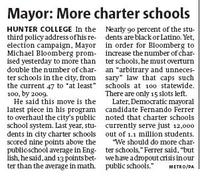
Bloomy Cans Cap and Charter Misinformation
I'm starting to feel like the New York Post with my cap-related headlines (maybe I should go all out and start calling it the New York Po$t?), but anyway. Here's what Bloomy has to say about charter schools in an election year. Here's what Freddy had to say:
I come across this misconception all the time, and many people are shocked to learn that charters receive public funds (if not an equal proportion), kids can go there for free, and they are required to take all city and state-mandated assessments. They must comply with No Child Left Behind if they receive Title I funding, which I would venture to guess that most of them do.
Charter schools are public schools. I bet if we did a better job at informing people of this fact, it wouldn't be as hard a struggle to lift the cap.
 P.S. Something else the public should know about charter schools -- a recent study shows that they don't serve a proportionate number of special ed students.
"We should do more charter schools," Ferrer said, "but we have a dropout crisis in our public schools."It is dismaying to me that someone running for mayor in this city is falling prey to the most common misconception about charter schools. Charter schools ARE public schools.
I come across this misconception all the time, and many people are shocked to learn that charters receive public funds (if not an equal proportion), kids can go there for free, and they are required to take all city and state-mandated assessments. They must comply with No Child Left Behind if they receive Title I funding, which I would venture to guess that most of them do.
Charter schools are public schools. I bet if we did a better job at informing people of this fact, it wouldn't be as hard a struggle to lift the cap.
P.S. Something else the public should know about charter schools -- a recent study shows that they don't serve a proportionate number of special ed students.
Saturday, October 08, 2005
I'm Depressed
This week, I was talking to a kid from Honduras in my after-school program about choosing a high school for next year. I brought up a high school in Queens for new immigrants, which generally do a great job teaching English to immigrant students quickly, since he arrived in the U.S. only a few months ago and speaks no English, and was surprised when he declared that he was not an immigrant because he had residency (i.e. he was here legally).
So this is where the immigration debate in this country is going - all immigrants are seen as law-breakers, and even a newly arrived kid who is not listening to the fanatics in the media and spends all his time (at school and in his neighborhood in New York City of all places) around immigrants from all over the world can pick up on this association.
Get off your ath let's do some math
Not in some classes at my school. A parent came in last week to complain that her son's class had been without a math teacher since the first week of school. She didn't speak much English, so the front office blew her off and told her to wait for a month until they found a new teacher.
It would have been great if the office had tried to communicate with the parent and listen to her concerns (or at least explain what was going on), but the real problem here, and it is a big one, is that some 7th graders are going without math teachers when they are required to pass a math exam in order to be promoted. Can we take Bloomy's and Klein's "no social promotion" policy seriously when they obviously are not putting enough resources towards retaining and hiring qualified teachers in high-need schools? Not having math teachers at this school shouldn't take anyone by surprise - apparently one class didn't have a teacher for several months last year.
Friday, October 07, 2005
Todo Mundo Quiere a Ramon??
The LA Times has a really interesting editorial (in Spanglish!) about the value of watching TV shows in another language after some cable viewers in Los Angeles had their favorite shows switched into Spanish this week.
Thursday, October 06, 2005
Cap Attack
Battle is brewing on charter schools
Forty-two charter school applications were submitted across New York by last week's deadline, setting up a potential showdown over the state's decision to limit the number of charter schools. State law allows just 100 charters - public schools operated independently of the local school system - to be set up. Eighty-four already have been granted.
New applications include 18 submitted to Schools Chancellor Joel Klein, who last month called the state cap "irrational and unfair."
One new application - for a high school - came from the city teachers union, which has fought against lifting the cap. The United Federation of Teachers already runs a charter school in Brooklyn.
Joe Williams, NY Daily News
Wednesday, October 05, 2005
The other other mayoral election
Remember the other mayoral election? Well, there's ANOTHER other mayoral election, this one on Buffalo, and charter schools are making a showing. The Republican candidate, Kevin Helfer, is taking a Bloomy-like stance on charter schools and centralized school management.
Buffalo's school system is having major financial problems, as evidenced by their health insurance woes. Charter schools may be partly to blame. The candidates are straddling the choice issue.
P.S., is this a direct dig at Bloomy by Democratic candidate Byron Brown?:
Buffalo's school system is having major financial problems, as evidenced by their health insurance woes. Charter schools may be partly to blame. The candidates are straddling the choice issue.
P.S., is this a direct dig at Bloomy by Democratic candidate Byron Brown?:
"While I'm going to be a hands-on manager, I don't believe the mayor should
micromanage things," Brown said.
Monday, October 03, 2005
Why can't we live in a Jeb Bartlett world?
On last night's West Wing, a reporter asks Josh if he had a comment on the New York Post. Josh says he's against it. And that remark is off the record.
I appreciated that comment even more so today after reading the NY Post's "INVESTIGATION" on "Teacher Brain Drain" in New York City.
Of course, being the NY Post, they try to play the blame game with the brain drain and blame it on seniority rules. They give a couple of lines to the UFT's argument, which is that "seniority transfers are a negligible factor in pay disparity, claiming just 118 veteran teachers fled low-performing schools for better ones last year. Seventy-six seasoned teachers did the opposite, the union said."
Where are all the teachers?
Last week the school where my after-school program is had "Meet the Teacher Night" for all the parents. I've been told by a number of teachers that this is the only event that parents actually come to, so all the SES (aggressive and reasonable alike) providers and the PTA were running around setting up for it. Parent involvement is a big problem at the school and the turnout that night was pretty light, but I was amazed to hear that a lot of teachers didn't come. If there is only one night to connect with parents, how is it possible that the school didn't put everything it had into making the night great for the parents that bothered to show up.
The problem here is not the teachers, of course. It's the system. I heard complaints from the teachers that were here about the lack of parents showing up. I'm sure teachers are frustrated about the lack of parent involvement over the years (I know I am in the after-school program, and we tend to have the more involved ones), so it's hard to criticize them for not wanting to spend another night at school while parents don't bother to come and meet them.
And of course there is the language problem - the school makes very little effort to provide translators (the orientation course for parents of English Language Learners was staffed by a teacher who spoke no Spanish, despite the fact that all the parents in the room were Spanish-speakers and spoke less English than their kids), so many teachers can't communicate with the mostly immigrant parent population even if both parents and teachers showed up.
I wonder how we can begin to break out of cycles like these. Translators would be a big step - a lot of immigrant parents probably come once and are blown off because they don't understand English. But the problem is bigger than just dealing with the language barrier - parents need to feel like partners in their kids education, and I don't feel like that is happening here.
Tuesday, September 27, 2005
Friday, September 23, 2005
Quiero hablar contigo
I was a little down this morning after reading about the test scores for 8th graders and thinking about how difficult this year is going to be. But the kids in the program always seem to pick me when I get discouraged. Today, a girl from Russia asked my co-worker how to say "I want to talk to you" in Spanish. She ran back over to her table and repeated it to another girl (a recent immigrant from South America). They met in their ESL class, and even though both spoke very little English, they were inseparable. Working with kids from neighborhoods with diverse immigrant populations makes me so hopeful sometimes.
Sort of like a snow day ..
From 11alive.com:
Governor Sonny Perdue has announced that he has requested that all the state's school systems take an "early snow day" and close on Monday and Tuesday of next week in a fuel saving measure as a result of Hurricane Rita."Any supply squeeze is temporary, and is nothing we can't handle," Perdue said.Perdue also has signed an executive order that eliminates non-essential travel by state employees.Perdue's office is also encouraging telecommuting and alternative scheduling by non-essential state offices in order to save on fuel costs.If all of Georgia's schools close, the governor estimated about 250,000 gallons of diesel fuel would be saved each day by keeping buses off the road.The governor also said an undetermined amount of regular gasoline also would be saved by allowing teachers, other school staff members and some parents to stay home those days. Electricity also would be conserved by keeping the schools closed.The Archdiocese of Atlanta has announced that all of their schools will be closed Monday and Tuesday in accordance with the governor's request.
NY State math scores in
The big news in all the New York papers today is that the scores from the 2005 Statewide Math tests have been released. (Here's the NY Times write up, and an editorial from the NY Daily News.)
The good news is that 4th grade math scores have gone up. The bad news is that it isn't news at all. These scores could have been released months ago, but the state has sat on them for god knows what political reasons.
The media have interpreted this as incompetence on the part of the state, as in this opinion piece from last Friday's NY Sun. I don't usually agree with Andrew Wolf, but I fully agree with this column, especially this:
We may have come to the moment when the stakeholders in our public schools
- parents, educators, and taxpayers - should demand new leadership in the state
agency. Commissioner Richard Mills - while saying that he supports testing -
has, through his bumbling administration of the testing program, undermined the
imperative of objective assessment. It is time for him to move on. We need a
state education chief and a department that are not paralyzed by bureaucratic
inertia.
Is competition among SES providers good for kids and parents?
This week my middle school held its SES (Supplemental Education Services) provider fair, which serves to inform parents of the free tutoring services and introduce them to the providers. The CBO and after school program that I work for provides SES (mostly just to the kids in after school), and there are also about 7 or 8 other companies this year, most of them for-profits. The for-profits had their slick sales representatives and glossy packets on display, and they really went after the parents hard.
The School of Bloggers think that having companies compete to give free services to poor and disadvantaged kids is probably a good thing. I see health insurance companies all over poor neighborhoods in New York City giving out insurance, and it seems like more people will take advantage of free services when they are actively recruited (and spoken to in their language, something that is noticeably lacking in many public institutions in this city). True to form, most of the companies brought Spanish translators to the fair while the school is usually unable to find one for parent meetings, although they did have one at the fair.
But although parents might feel like their kids are getting better services as a result of the competition (I really have no idea whether this is true, but there are a lot of stories about terrible SES providers - I remember a story about kids in a Platform Learning program just watching movies all the time), most of the parents I talked to at the fair seemed confused and totally overwhelmed. There were so many providers that the administrators rushed through the description of what SES was and didn't give the translator much time at all, so most of the parents had no idea what they were signing up for.
If this is the case, does it really make a difference how many providers there are in the school? Even if parents understood what was going on, how can they possibly choose the best provider for their kid when they are being bombarded for all sides by sales representatives? Maybe having agressive providers can be a good thing if they are able to reach more parents at home (there were a very small number of parents at the fair), but I'm worried that the cutthroat competition at the school will turn a lot of parents off and push them to avoid the whole thing.
Wednesday, September 21, 2005
Student Protests in the Bronx
Interesting article in the NY Times today about the student response to increased security measures at a high school in the Bronx. 1500 students walked out of the high school and got their meeting with DOE officials. Their demands (they want the metal detectors to be removed and they want to be able to leave school for lunch) weren't met, but the school administration seems to be listening. It's great that these kids are responding in such a constructive way to security measures that treat kids like criminals. I'm definitely bringing this up with the middle schoolers in my after school program, especially since there is talk of requiring ID cards for all students in the school this year.
Tuesday, September 20, 2005
Monday, September 19, 2005
Bad bloggers
The School of Bloggers apologize for their poor blogging behavior! They spent the weekend far, far away from noisy Brooklyn on Lake Chatuge in North Carolina.
Nor do I have time to say anything profound right now, even though there is SO MUCH TO BLOG ABOUT. So I will let the Public Education Network's "Quote of the Week" say it for me.
"Democratic values are a necessary, even if not sufficient, condition for defending the existence of a system of public education. Only from a democratic perspective can one claim that the schools have an impact on and responsibility to the whole society and that as a result they are a democratic decision making. From Jefferson to Dewey to Mann, and especially during the heyday of progressive education, such ideas were at the center of educational politics. In their absence, there is no longer any convincing rationale to keep the school public and social in terms oftheir governance, finance, and pedagogy.
The battleground over their future is thus yielded to those who argue that the market can and should make such determinations. This ultimately supports a system of privatized schools in an educational free market, linked to a curricular agenda defined by the needs of a capitalist economy and the national-security state associated with it. In short, we cannot defend public education, mobilize a constituency behind it, or achieve the visions of democratic educators without a clear and convincing democratic ideological framework that provides a rationale for maintaining a socially owned, controlled,and financed school system. If the market prevails as a model for organizing U.S. education, the possibilities for strengthening a democratic society and developing a democratic citizenry are ended."
-Michael Engel (author/professor/school board member), "The Struggle forControl of Public Education: Market Ideology vs. Democratic Values
Wednesday, September 14, 2005
Moskowitz Moskowitz Moskowitz
The results are in from yesterday's Democratic primary. Weiner conceded to Ferrer to prevent a run-off election. Other people we liked, including Mike Peters who ran for Brooklyn district attorney, didn't do as well. School of Bloggers' buddy and City Councilmember David Yassky was not running for anything, but City Councilmember (and charter school aunt) Letitia James did run for reelection and won in a landslide.
The only other remarkable occurrence was the failure of Eva Moskowitz (city councilmember and head of the Education Committee) to take the Manhattan Borough President seat. Read all about it over at Eduwonk.
Monday, September 12, 2005
The Facilitator
I would be remiss if I didn't mention this story, for those of you who haven't heard about it yet.
The National Alliance for Public Charter Schools' headline on this story is "NYC to become national leader on facilities."
What's up with the timing here? It was announced four days before the Democrats' mayoral primary, and a scant two months before the election. Are charter schools really that popular in the city that Bloomy feels they'll give him a boost?
Thoughts
No no, I am not becoming an establishment-hating radical after one week of courses. My "Inquiries"-related ennui is not making me regret my decision to enroll in a teacher certification program rather than going the emergency certification route.
I just question the value of certain curricular requirements toward achieving that goal.
BTW, it's not just my program; all New York State teaching candidates must take "college coursework" in "foundations in education."
And BTW again, maybe my rebellious spirit is the result of the undemocratic way in which the state tells me I must learn how to be a teacher. Paulo Freire meets the Gadfly!
Friday, September 09, 2005
First day of Petrie dish
Lots on the first day of school in today's papers, especially on the first day of the UFT charter school.
Sad, very sad
Re: this, this columnist argues, among other things, that education schools (including, presumably, the school at which he teaches and I learn) don't do enough to give teachers a strong background in their content. He says:
I am definitely feeling that after my 2 classes last night. Actually, the "methods" class seemed like the more useful one. It's "Inquiries into Teaching and Learning" that is making me want to poke my eyeballs out.
Our schools of education are also at fault, saddling future teachers with
"methods" courses at the expense of disciplinary content.
I am definitely feeling that after my 2 classes last night. Actually, the "methods" class seemed like the more useful one. It's "Inquiries into Teaching and Learning" that is making me want to poke my eyeballs out.
Thursday, September 08, 2005
How NYSED
The state came out with its annual report on charter schools this week, based on the 2003-04 school year. (Can the state do anything on time?) Report here, Albany Times-Union here.
The gist: Charter schools in N.Y. state are doing better in general, but are draining money from the traditional public schools.
One more tidbit for follow-up: According to the report, less than 2 percent of charter school students in N.Y. are English language learners. That seems REALLY low, doesn't it?
Chris, any idea?
Wednesday, September 07, 2005
Like Arnie's plan but with much more tact
Here's a roundup of the stories I would have pontificated about today had I had time:
- Rep. Rangel and Teachers College pres Arthur Levine have proposed pay incentives to attract teachers to hard-to-staff schools. Story here, Eduwonk here.
- Two new studies of charter schools by the big boys in the evaluating world, one on Chicago and one on North Carolina. Results: Charter schools are effective in some grades, under some conditions, some of the time. My conclusion: Stop trying to prove that charter schools are or are not more effective than non-charter public schools. Start trying to figure out what the good schools do that makes them effective.
- The Education Department has paid people to write anti-public school op/eds. Well, that is a slight exaggeration; but what is certainly clear is that the Bush administration has put a lot of money into propping up minority-focused organizations (like Hispanic CREO, referenced in this article) that are really just front organizations for their conservative friends.
Tuesday, September 06, 2005
UFT Charter School Opens on Thursday
Daily News write up here. More on this later this week once the School of Bloggers get internet access at home.
Friday, September 02, 2005
Fighting for Translation in Schools
Here is a good Newsday article about advocacy groups in New York City putting the pressure on the Department of Education to provide translation services to immigrant parents.
Bush and Bilingual Education II
The New York Times editorial page weighs in on the controversy surrounding the Bush administration's decision not to publish a report on bilingual education that is at odds with conservative opinion (previous post here). The editorial calls on Bush to allow the researchers to publish the report privately, which is probably the best option seeing how Bush is unlikely to anger conservatives at a time when he is being criticized from the right on immigration.
I understand that there will always be some opposition to teaching immigrant students in a language other than English for political and cultural reasons, but if bilingual education does indeed offer limited English proficient kids the best possible chance of succeeding academically (which the report supposedly says), shouldn't we be giving it a shot? At the very least we should be debating it and commissioning other studes, which can't happen until the administration allows the report to see the light of day.
"We'll need your help"
Public school advocate Sen. Mary Landrieu from Louisiana calls for support in the Washington Post. (Via National Alliance for Public Charter Schools)
Thursday, September 01, 2005
War of attrition
Two really interesting NCLB-related stories today:
Spellings is wise to give flexibility in the first case, and would be wise to give flexibility in the second. Addressing these two issues is a reasonable thing to do, and doesn't detract from what, to me, is the important part of NCLB: making sure that all subgroups of students are on their way to proficiency, and aren't being ignored.
- Spellings is going to let Chicago run its own Supplemental Educational Services program (SES), even though the district as a whole is not making AYP
- The people of California are annoyed that schools that look good under their own accountability system are not making AYP.
Spellings is wise to give flexibility in the first case, and would be wise to give flexibility in the second. Addressing these two issues is a reasonable thing to do, and doesn't detract from what, to me, is the important part of NCLB: making sure that all subgroups of students are on their way to proficiency, and aren't being ignored.
For-profit EMO loses its groove in NY
No, i'm not talking about emo. I'm talking about an Education Management Organization, in particular Imagine Schools, formerly Chacellor-Beacon Schools, a for-profit company that runs a bunch of charters.
The Syracuse Post-Standard looked into whether the company is losing ground across the country, something that certainly seems to be the case in New York State. The company was charging the Central New York Charter School for Math and Science high fees, but not delivering the kind of management they needed, leading to the school losing its charter.
Yet another argument (as if we needed any more!) against education's profiteers.
The Syracuse Post-Standard looked into whether the company is losing ground across the country, something that certainly seems to be the case in New York State. The company was charging the Central New York Charter School for Math and Science high fees, but not delivering the kind of management they needed, leading to the school losing its charter.
By the time the school was forced to close on June 30, it was supposed to have paid Imagine $475,616 for the 2004-05 academic year, according to the charter school's financial statements. That represents a 40 percent increase above the $338,734 annual fee paid the previous year.
"I didn't ever really understand what we paid them to do," said Kelly Norcross, one of 45 teachers at the school who lost their jobs this summer when the state pulled the school's authorization. "At the end of the year, that's when I started seeing them. As far as everyday school, we never saw them."
Yet another argument (as if we needed any more!) against education's profiteers.
Which side are you on?
The NY Sun is on top of yesterday's NYU rally, with full coverage and a lead editorial. The Sun points out that fewer than 100 actual NYU grad students were in attendance, which apparently means "that most graduates realize who is on their side."
Yes, the Sun editorial is all about "which side are you on," but in this case it's not either workers or management, but "Defenders of academic freedom" or "the left wing of the labor movement."
By making this argument, the Sun is wholeheartedly buying into NYU's argument that they are opposing the union to somehow protect the academic interests of the grad students. This is the argument that all companies make when they oppose unions: saying "we care" while simultaneously endorsing policies that exploit workers.
By the way, classes don't start for another week at NYU, a fact that the Sun neglects when reporting that "fewer than 100 NYU graduate students joined him at the protest out of a bargaining unit of 1,000."
UPDATE: By the way, Miller did show up.
Subscribe to:
Posts (Atom)