College Grads Who Are Illegal Immigrants Face Barren Job MarketBY DANIELA
GERSON - Staff Reporter of the SunNovember 22, 2005URL: http://www.nysun.com/article/23358Each year, thousands of New York City students earn college degreesand yet have no possibility of finding work. The reason is not a lackof job offers, but because they are illegal immigrants."We have people who graduate at the top of their classes and they can't get jobs," the director of the City University of New York's Citizenship and Immigration Project, Allan Wernick, said yesterday at a City Council hearing. By recent counts, he said, there are 3,000 undocumented students in the CUNY system. Nationally, 65,000 illegal immigrant students are thought to graduate from high school each year. Alfredo, an illegal immigrant who is a senior at Baruch College, is facing the prospect of graduating this spring with a degree in business administration and no potential to work legally. At 10, his parents brought him to Long Island from Guatemala, but it was onlyyears later that he realized the implications of being illegal. "Inever thought it was such
a big issue until I started hitting theroadblocks," the 21-year-old said, noting
that teachers began tonominate him for awards he could not accept without a
Social Securitynumber. On Friday, a glimmer of hope appeared for immigrants such
as Alfredo. The Senate reintroduced legislation that would grant students
the opportunity to become permanent legal residents. If President Bush signs it by
the end of 2006, the bill, known as the Dream Act, would allow students to
receive temporary legal status when they graduate from high school. Upon
completing their studies or military service, the immigrants could then apply for
permanent legal status.
Additionally, the legislation would increase the number of statesoffering instate tuition to undocumented students and make more financial aid available. Unlike most other states across the country, schools in New York offer in-state tuition to immigrant students who have lived in the state, regardless of status.However, even the $4,000 tuition for senior colleges in the CUNYsystem or $2,800 for junior colleges can be a stretch for some immigrants. A teacher with dozens of undocumented students at Flushing High School in Queens, Martha Cruz, said some of her best students could not join their peers in college because their illegal status bars them from most forms of financial aid."I have one who graduated with over an 83 average and he's working at McDonald's because he wants to save to go to college, plus he has to help out at home," Ms. Cruz said. "If they continue to be undocumented they will work menial jobs." In Alfredo's case, his parents rented out two rooms in their Long Island house so he could attend Baruch. Unable to work legally while in college, he has helped cover his educationfees by working at restaurants for under-the-table pay.The evident humanitarian and economic case for providing students who had no choice in immigrating illegally to America with a chance to study and work make it a fairly popular bill. Critics, nonetheless, say it is a
sugar-coated amnesty rewarding illegality. Still, the Dream Act is generally
considered the immigrationlegislation most likely to pass next term. Senators
Clinton andSchumer were both cosigners of the initial bill but have not
yetsigned on to the reintroduced bill.For Alfredo, who is heading a campaign
with the CUNY Senate's newlyformed immigration committee to bring attention to
the issue, theDream Act is a question of practicality. "Without it there's
really nofuture for me. Even though I will have a bachelor's degree, I'm
goingto have to work some low-wage job," he said. "It makes sense forAmerica to
let me participate as much as I can."November 22, 2005 Edition >
Tuesday, November 22, 2005
DREAM Act Reintroduced


Friday, November 18, 2005
Sending Immigrant Kids Back Home
It should be worth it to Bloomy to make an effort to provide affordable childcare for immigrant families, if only to start investing now in these kids' futures. No reason to focus all the attention on test scores in elementary and middle school when some immigrant kids are being left behind a lot earlier.
Wednesday, November 16, 2005
new orleans school takeover .. ?
Monday, November 14, 2005
mooooo.
Sent Monday, November 14, 2005 8:53 pm
Subject Tuesday meeting place
Yes, we have a place to meet tomorrow:
McDonald's ... they will allow us to meet upstairs so even if they have that area blocked off when you go in - fear not - they are expecting us and our discussion of Dewey.
Nutrition aside, please try to buy something as you come in..... as thanks....
Now THERE's an ethical dilemma for you. I haven't stepped into a McDonalds in many, many years. Not that I really have a choice in the matter. But an interesting question still: which is worse, patronizing a university that union-busts, or patronizing one of the more evil companies in the world?
Saturday, November 12, 2005
El Seviche
There have been a lot of problems with ethnic and racial tensions in the school recently (more on that in the next post), but it was really nice to see so many of the kids show some pride and emotion when talking about their countries.
Monday, November 07, 2005
More always enlightening
It's one of our favorite topics too (past posts here and here), so I'll risk whatever consequences it may bring and post excerpts from the column for those of you not graced with Times Select.
Here's the nut graf:
The funny thing is that the solution - national health insurance, available to everyone - is obvious. But to see the obvious we'll have to overcome pride - the unwarranted belief that America has nothing to learn from other countries - and prejudice - the equally unwarranted belief, driven by ideology, that private insurance is more efficient than public insurance.
Huhhhh?? He explains further:
The journal Health Affairs recently published the results of a survey of the medical experience of "sicker adults" in six countries, including Canada, Britain, Germany and the United States. The responses don't support claims about superior service from the U.S. system. It's true that Americans generally have shorter waits for elective surgery than Canadians or Britons, although German waits are even shorter. But Americans do worse by some important measures: we find it harder than citizens of other advanced countries to see a doctor when we need one, and our system is more, not less, rife with medical errors.
Above all, Americans are far more likely than others to forgo treatment because they can't afford it. Forty percent of the Americans surveyed failed to fill a prescription because of cost. A third were deterred by cost from seeing a doctor when sick or from getting recommended tests or follow-up.
Krugman, I have observed this phenomenon in my own employer-provided health insurance plan. In fact, it has been nearly impossible to find a doctor who actually exists and who will see me. Why is this?
The U.S. system is much more bureaucratic, with much higher administrative costs, than those of other countries, because private insurers and other players work hard at trying not to pay for medical care. And our fragmented system is unable to bargain with drug companies and other suppliers for lower prices.
Friday, November 04, 2005
academia's corporate apologists strike again
The United Auto Workers union has announced that it has decided to proceed with a “strike.” I want to reassure you that classes will continue to go forward and we will do our best to minimize the impact of any disruption the UAW may cause.
As you know, the University entered into a contract with the UAW in 2001, the first and only private university to do so. We had choices, but we decided to enter into a contract because the union committed – in writing – not to interfere with NYU’s academic decision-making. Regrettably, they broke that promise. In so doing, they damaged a genuine opportunity for partnership. Remarks from the union leadership, as recently as this past week, establish that they continue to believe that grievances of academic decisions, including who should be appointed to teach, are appropriate.
Still, in August we proposed a new agreement: recognition of the UAW as the bargaining agent for our graduate students on economic matters (stipends, health care, employment conditions), but not academic matters. We made this proposal to bridge the goals important to the University and the UAW. The union unambiguously rejected the proposal.
We have tried to find a way to make it work with the UAW, twice. At some point, one must turn from trying to mend an imperfect past and towards creating a better future.
So, we have implemented increases in stipends ($1000 per year for three years), and a commitment to an “evergreen” look ahead to enable graduate students to know the financial aid support three years in advance. A committee of graduate student representatives has begun work on a new grievance procedure and a rights-and-responsibility compact.
The UAW is now threatening to disrupt classes. In moving forward after the UAW rejected our proposal, the University was aware that the UAW might threaten class disruptions. You are entitled to ask “Is this worth it?” The answer to that question lies not in whether the autoworkers union chooses to disrupt classes, but in whether the University’s decision advances or erodes NYU’s long-term efforts to achieve academic excellence. Along with many others on campus, I believe it will advance them.
NYU values the freedom to express differences of opinion. In an academic environment, however, disrupting classes is not an appropriate form of expression. An academic institution and its faculty must be committed to classes going forward, to teaching and learning continuing, and to supporting all its students – including its graduate assistants – as they pursue their education. In a community of scholars, this is our vocation, and it is the right course. Despite what may happen over the coming days, we cherish all of our students. We will remain committed to them, to their studies, and to their scholarly aspirations, and to your academic progress.
Sincerely,
David McLaughlin, Provost
Wednesday, November 02, 2005
NYU grad students to strike
Monday, October 31, 2005
Blaming Ilegal Immigrants
The mayoral debate
"Look, I'm not running to be the mayor of the fourth grade. I'm running to be the mayor of all the grades."
- Freddy Ferrer, in the debate with Bloomy last night. Apparently it was one of the only good jabs he had at Bloomy.
Bonus observation: Has anyone else noticed that both Bloomy and Freddy strikingly resemble woodland creatures?
Update: 
Not signing up for SES
The other problem with SES is that when parents do understand and come in to sign their kids up, they are immediately attacked by the for-profit company that has set up shop in and around the school. It's a confusing process anyway, and I think it is being made worse by the cutthroat competition among providers. The word may be getting out more because of the resources from the for-profit companies, but it's obviously not sinking in. Maybe all the providers should take a deep breath and remember that the kids really need the extra help with all the focus on testing. But parents have to be involved in the decision, not just hit up for their signature on the provider form, in order for the kids to get the help.
Friday, October 28, 2005
Maple Syrup!
Then, in today's New York Post, I read this:
STRONG WHIFF OF WORRY DOWNTOWN
By PHILIP MESSING
A peculiar and mysterious smell enveloped lower Manhattan for several hours last night, sparking dozens of 311 calls, authorities said.
Pedestrians around City Hall claimed there was an overpowering smell reminiscent of pancakes or maple syrup.
"A significant number of calls came in to the 311 system," said Jared Bernstein, a spokesman for the city's Office of Emergency Management. "We are taking it very seriously — in this day and age we take everything seriously."
Bernstein said city officials were working — with a variety of state and federal officials — to determine where the smell originated.
Update: Gothamist is on the case. (Check out all the comments!)
Wednesday, October 26, 2005
Ravitching and moaning
Business AND goverment facing a crisis of confidence?
POLL SHOWS RISE IN NEGATIVE FEELINGS TOWARD GOVERNMENT, BUSINESSEmphasis added. This is a big, big deal. Public confidence in business is waning (things like this don't help) AND public confidence in goverment is waning (things like this certainly don't help).
The public's view of the government has eroded over the past year and its view of business corporations is now at the lowest level in two decades. The public's rating for the federal government has fallen from 59% favorable last year to 45% now, according to a poll by the Pew Research Center for the People & the Press. The favorable view of business corporations is also at 45%.
- Associated Press
What does this mean? Organized labor may be due for a comeback ...
Tuesday, October 25, 2005
The School of Bloggers are on the map!
*Out of 26
**Which we did by signing ourselves up here.
Friday, October 21, 2005
NYU Grad students to strike?
By now many of you are aware that the United Auto Workers is publicly discussing a job action involving graduate assistants (GAs) at NYU in the near future.
In our opinion, the Auto Workers union is embarking on a regrettable and unfortunate course: regrettable because it fails to respect the significance of your efforts to pursue your education, and unfortunate because such an action will not result in recognition of the UAW to represent our graduate assistants.
We understand that the possibility of a job action is the last thing you need at this point in the school year. We want to reassure you that the University will maintain your academic progress.
...
The United Auto Workers union has been publicly discussing the prospects of engaging in a job action for quite some time; accordingly, the University has been planning for this possibility. Regardless of whether or not some GAs strike, the University will remain open, and you should plan on attending your classes and participating in your regularly scheduled activities. We have been faculty members and administrators at NYU for decades, and we believe that our faculty colleagues, recognizing the professional responsibility that accompanies the trust you have placed in NYU to educate you, will hold classes, and ensure your academic progress.
If there is a disruption, you will promptly hear from your school’s dean, who will provide you with further information and give you contact information should you have any concerns or questions.
We cannot promise you there will be no disruptions, but we are working hard to ensure that they are minimal. We believe that a large majority of GAs will continue to fulfill their teaching responsibilities. The University and its deans, faculty, and administrators will do whatever is necessary to guarantee that your hard work this semester is not put at risk, that your academic program and course work will be completed, and that those of you who are scheduled to graduate will do so.
Sincerely,
John Sexton David McLaughlin
President Provost
Thursday, October 20, 2005
blame the immigrants!
In an interview, Ms. Spellings called attention to the improvement in math by fourth graders. She said the less robust increases and outright declines in some reading scores were understandable in part, because the nations schools are assimilating huge numbers of immigrants.When the program isn't educating the "hard-to-educate" students, maybe you need to rethink the program.
"We have more non-native speakers, there are lots of so-called at-risk, hard-to-educate students, and in spite of that, steady progress is being made," she said. "We're on the right track with No Child Left Behind."
Steven Sanders resigning
Longest Tenured Assembly Education Chairman Retires
BY MICHAEL GORMLEY -
Associated Press
October 20, 2005
URL:
http://www.nysun.com/article/21807
ALBANY, N.Y. - The state assembly education committee chairman, Steven Sanders, announced yesterday he will retire from the chamber after 28 years.
Mr. Sanders, a Manhattan Democrat, was the influential chairman of the committee for 11 years. He was the longest tenured chairman for that post.
Mr. Sanders, 54, said he is resigning effective January 1 for "personal and family considerations."
"My time in the state Assembly has been incredibly rewarding, and I thank Speaker Silver for his leadership and personal friendship," Mr. Sanders said yesterday. Mr. Sanders helped lead the state to historic increases in state school aid since 1995, exceeding the increased aid often proposed in Governor Pataki's executive budgets. Education has become the largest percentage of the budget, and more state funds are now directed to the neediest schools.
Monday, October 17, 2005
Principal Skinner speaks
(Be sure to scroll down to the end.)
Wednesday, October 12, 2005
Superheroes in Brooklyn?
The article describes 826 Valencia, a pirate shop in San Francisco that is a front for a mysterious drop-in tutoring center. There is one in Brooklyn too -- in my backyard all this time and I never knew about it! The storefront is, apparently, a superhero supply store, but education goes on within.
The creator of 826 Valencia, David Eggers, has taken on teacher pay as a cause. He wrote another piece for the Guardian on teacher pay in the U.S., and at the end of the article there's this table comparing the average salaries of teachers in the U.S. and England:
Comparative studyAt first glance, U.S. teachers seem to be doing okay, at least comparatively. Their starting salaries are higher, and they have a smaller average class size in the early grades. But look at the number of contracted hours (even though it is safe to assume that teachers in both countries are working far more than that).
Starting salary for primary teacher
England: $28,608 USA: $30,339
Salary after 15 years for primary teacher
England: $41,807 USA: $ 43,999
Number of students per teacher primary
England: 20 USA: 15.5
Number of students per teacher secondary
England: 14.8 USA: 15.5
Contracted hours, full-time teacher primary
England: 1,265 USA: 1,353
Contracted hours, full-time teacher secondary
England: 1,265 USA: 1,371
Source: OECD Education at a Glance 2005. 2003 figures.
Bottom line is that in neither country are teachers paid what they should be. In Japan, average teacher salary is about $52,500 a year.
Anyway, if you haven't already, spend some time with the Guardian. There's just loads of stuff, from basic skills to the naked chef.
Pushing Kids out of High School
Michael Best, the Education Department's top lawyer, issued a statement that did not address the allegations in the suit but said the parents should have asked school officials for help.
Can he possibly be serious that parents were expected to get help from the same school officials that were illegally pushing their kids out of school?
And how about the response of the school's former principal? He basically blamed the kids.
In an interview yesterday, Mr. Mickens complained that large schools were being forced to take all of the city's special education students and students with behavior problems while the small schools being created by the mayor were not admitting these children. "I am not going to sit there as principal and welcome a student who threatens me or my staff," he said. "I stand by my record."
So there you have it - this high school wasn't pushing students out of school despite all the evidence compiled by Advocates for Children, but even if it was, it is the students' and parents' fault anyway.
Tuesday, October 11, 2005
Bloomy Cans Cap and Charter Misinformation
"We should do more charter schools," Ferrer said, "but we have a dropout crisis in our public schools."It is dismaying to me that someone running for mayor in this city is falling prey to the most common misconception about charter schools. Charter schools ARE public schools.
I come across this misconception all the time, and many people are shocked to learn that charters receive public funds (if not an equal proportion), kids can go there for free, and they are required to take all city and state-mandated assessments. They must comply with No Child Left Behind if they receive Title I funding, which I would venture to guess that most of them do.
Charter schools are public schools. I bet if we did a better job at informing people of this fact, it wouldn't be as hard a struggle to lift the cap.
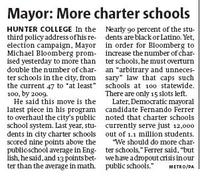 P.S. Something else the public should know about charter schools -- a recent study shows that they don't serve a proportionate number of special ed students.
Saturday, October 08, 2005
I'm Depressed
So this is where the immigration debate in this country is going - all immigrants are seen as law-breakers, and even a newly arrived kid who is not listening to the fanatics in the media and spends all his time (at school and in his neighborhood in New York City of all places) around immigrants from all over the world can pick up on this association.
Get off your ath let's do some math
It would have been great if the office had tried to communicate with the parent and listen to her concerns (or at least explain what was going on), but the real problem here, and it is a big one, is that some 7th graders are going without math teachers when they are required to pass a math exam in order to be promoted. Can we take Bloomy's and Klein's "no social promotion" policy seriously when they obviously are not putting enough resources towards retaining and hiring qualified teachers in high-need schools? Not having math teachers at this school shouldn't take anyone by surprise - apparently one class didn't have a teacher for several months last year.
Friday, October 07, 2005
Todo Mundo Quiere a Ramon??
Thursday, October 06, 2005
Cap Attack
Forty-two charter school applications were submitted across New York by last week's deadline, setting up a potential showdown over the state's decision to limit the number of charter schools. State law allows just 100 charters - public schools operated independently of the local school system - to be set up. Eighty-four already have been granted.
New applications include 18 submitted to Schools Chancellor Joel Klein, who last month called the state cap "irrational and unfair."
One new application - for a high school - came from the city teachers union, which has fought against lifting the cap. The United Federation of Teachers already runs a charter school in Brooklyn.
Joe Williams, NY Daily News
Wednesday, October 05, 2005
The other other mayoral election
Buffalo's school system is having major financial problems, as evidenced by their health insurance woes. Charter schools may be partly to blame. The candidates are straddling the choice issue.
P.S., is this a direct dig at Bloomy by Democratic candidate Byron Brown?:
"While I'm going to be a hands-on manager, I don't believe the mayor should
micromanage things," Brown said.
Monday, October 03, 2005
Why can't we live in a Jeb Bartlett world?
I appreciated that comment even more so today after reading the NY Post's "INVESTIGATION" on "Teacher Brain Drain" in New York City.
Of course, being the NY Post, they try to play the blame game with the brain drain and blame it on seniority rules. They give a couple of lines to the UFT's argument, which is that "seniority transfers are a negligible factor in pay disparity, claiming just 118 veteran teachers fled low-performing schools for better ones last year. Seventy-six seasoned teachers did the opposite, the union said."
Where are all the teachers?
The problem here is not the teachers, of course. It's the system. I heard complaints from the teachers that were here about the lack of parents showing up. I'm sure teachers are frustrated about the lack of parent involvement over the years (I know I am in the after-school program, and we tend to have the more involved ones), so it's hard to criticize them for not wanting to spend another night at school while parents don't bother to come and meet them.
And of course there is the language problem - the school makes very little effort to provide translators (the orientation course for parents of English Language Learners was staffed by a teacher who spoke no Spanish, despite the fact that all the parents in the room were Spanish-speakers and spoke less English than their kids), so many teachers can't communicate with the mostly immigrant parent population even if both parents and teachers showed up.
I wonder how we can begin to break out of cycles like these. Translators would be a big step - a lot of immigrant parents probably come once and are blown off because they don't understand English. But the problem is bigger than just dealing with the language barrier - parents need to feel like partners in their kids education, and I don't feel like that is happening here.
Tuesday, September 27, 2005
Friday, September 23, 2005
Quiero hablar contigo
Sort of like a snow day ..
Governor Sonny Perdue has announced that he has requested that all the state's school systems take an "early snow day" and close on Monday and Tuesday of next week in a fuel saving measure as a result of Hurricane Rita."Any supply squeeze is temporary, and is nothing we can't handle," Perdue said.Perdue also has signed an executive order that eliminates non-essential travel by state employees.Perdue's office is also encouraging telecommuting and alternative scheduling by non-essential state offices in order to save on fuel costs.If all of Georgia's schools close, the governor estimated about 250,000 gallons of diesel fuel would be saved each day by keeping buses off the road.The governor also said an undetermined amount of regular gasoline also would be saved by allowing teachers, other school staff members and some parents to stay home those days. Electricity also would be conserved by keeping the schools closed.The Archdiocese of Atlanta has announced that all of their schools will be closed Monday and Tuesday in accordance with the governor's request.
NY State math scores in
The good news is that 4th grade math scores have gone up. The bad news is that it isn't news at all. These scores could have been released months ago, but the state has sat on them for god knows what political reasons.
The media have interpreted this as incompetence on the part of the state, as in this opinion piece from last Friday's NY Sun. I don't usually agree with Andrew Wolf, but I fully agree with this column, especially this:
We may have come to the moment when the stakeholders in our public schools
- parents, educators, and taxpayers - should demand new leadership in the state
agency. Commissioner Richard Mills - while saying that he supports testing -
has, through his bumbling administration of the testing program, undermined the
imperative of objective assessment. It is time for him to move on. We need a
state education chief and a department that are not paralyzed by bureaucratic
inertia.
Is competition among SES providers good for kids and parents?
The School of Bloggers think that having companies compete to give free services to poor and disadvantaged kids is probably a good thing. I see health insurance companies all over poor neighborhoods in New York City giving out insurance, and it seems like more people will take advantage of free services when they are actively recruited (and spoken to in their language, something that is noticeably lacking in many public institutions in this city). True to form, most of the companies brought Spanish translators to the fair while the school is usually unable to find one for parent meetings, although they did have one at the fair.
But although parents might feel like their kids are getting better services as a result of the competition (I really have no idea whether this is true, but there are a lot of stories about terrible SES providers - I remember a story about kids in a Platform Learning program just watching movies all the time), most of the parents I talked to at the fair seemed confused and totally overwhelmed. There were so many providers that the administrators rushed through the description of what SES was and didn't give the translator much time at all, so most of the parents had no idea what they were signing up for.
If this is the case, does it really make a difference how many providers there are in the school? Even if parents understood what was going on, how can they possibly choose the best provider for their kid when they are being bombarded for all sides by sales representatives? Maybe having agressive providers can be a good thing if they are able to reach more parents at home (there were a very small number of parents at the fair), but I'm worried that the cutthroat competition at the school will turn a lot of parents off and push them to avoid the whole thing.
Wednesday, September 21, 2005
Student Protests in the Bronx
Tuesday, September 20, 2005
Monday, September 19, 2005
Bad bloggers
Nor do I have time to say anything profound right now, even though there is SO MUCH TO BLOG ABOUT. So I will let the Public Education Network's "Quote of the Week" say it for me.
"Democratic values are a necessary, even if not sufficient, condition for defending the existence of a system of public education. Only from a democratic perspective can one claim that the schools have an impact on and responsibility to the whole society and that as a result they are a democratic decision making. From Jefferson to Dewey to Mann, and especially during the heyday of progressive education, such ideas were at the center of educational politics. In their absence, there is no longer any convincing rationale to keep the school public and social in terms oftheir governance, finance, and pedagogy.
The battleground over their future is thus yielded to those who argue that the market can and should make such determinations. This ultimately supports a system of privatized schools in an educational free market, linked to a curricular agenda defined by the needs of a capitalist economy and the national-security state associated with it. In short, we cannot defend public education, mobilize a constituency behind it, or achieve the visions of democratic educators without a clear and convincing democratic ideological framework that provides a rationale for maintaining a socially owned, controlled,and financed school system. If the market prevails as a model for organizing U.S. education, the possibilities for strengthening a democratic society and developing a democratic citizenry are ended."
-Michael Engel (author/professor/school board member), "The Struggle forControl of Public Education: Market Ideology vs. Democratic Values
Wednesday, September 14, 2005
Moskowitz Moskowitz Moskowitz
The only other remarkable occurrence was the failure of Eva Moskowitz (city councilmember and head of the Education Committee) to take the Manhattan Borough President seat. Read all about it over at Eduwonk.
Monday, September 12, 2005
The Facilitator
The National Alliance for Public Charter Schools' headline on this story is "NYC to become national leader on facilities."
What's up with the timing here? It was announced four days before the Democrats' mayoral primary, and a scant two months before the election. Are charter schools really that popular in the city that Bloomy feels they'll give him a boost?
Thoughts
I just question the value of certain curricular requirements toward achieving that goal.
BTW, it's not just my program; all New York State teaching candidates must take "college coursework" in "foundations in education."
And BTW again, maybe my rebellious spirit is the result of the undemocratic way in which the state tells me I must learn how to be a teacher. Paulo Freire meets the Gadfly!
Friday, September 09, 2005
First day of Petrie dish
Sad, very sad
Our schools of education are also at fault, saddling future teachers with
"methods" courses at the expense of disciplinary content.
I am definitely feeling that after my 2 classes last night. Actually, the "methods" class seemed like the more useful one. It's "Inquiries into Teaching and Learning" that is making me want to poke my eyeballs out.
Thursday, September 08, 2005
How NYSED
The gist: Charter schools in N.Y. state are doing better in general, but are draining money from the traditional public schools.
One more tidbit for follow-up: According to the report, less than 2 percent of charter school students in N.Y. are English language learners. That seems REALLY low, doesn't it?
Chris, any idea?
Wednesday, September 07, 2005
Like Arnie's plan but with much more tact
- Rep. Rangel and Teachers College pres Arthur Levine have proposed pay incentives to attract teachers to hard-to-staff schools. Story here, Eduwonk here.
- Two new studies of charter schools by the big boys in the evaluating world, one on Chicago and one on North Carolina. Results: Charter schools are effective in some grades, under some conditions, some of the time. My conclusion: Stop trying to prove that charter schools are or are not more effective than non-charter public schools. Start trying to figure out what the good schools do that makes them effective.
- The Education Department has paid people to write anti-public school op/eds. Well, that is a slight exaggeration; but what is certainly clear is that the Bush administration has put a lot of money into propping up minority-focused organizations (like Hispanic CREO, referenced in this article) that are really just front organizations for their conservative friends.
Tuesday, September 06, 2005
UFT Charter School Opens on Thursday
Friday, September 02, 2005
Fighting for Translation in Schools
Bush and Bilingual Education II
I understand that there will always be some opposition to teaching immigrant students in a language other than English for political and cultural reasons, but if bilingual education does indeed offer limited English proficient kids the best possible chance of succeeding academically (which the report supposedly says), shouldn't we be giving it a shot? At the very least we should be debating it and commissioning other studes, which can't happen until the administration allows the report to see the light of day.
"We'll need your help"
Thursday, September 01, 2005
War of attrition
- Spellings is going to let Chicago run its own Supplemental Educational Services program (SES), even though the district as a whole is not making AYP
- The people of California are annoyed that schools that look good under their own accountability system are not making AYP.
Spellings is wise to give flexibility in the first case, and would be wise to give flexibility in the second. Addressing these two issues is a reasonable thing to do, and doesn't detract from what, to me, is the important part of NCLB: making sure that all subgroups of students are on their way to proficiency, and aren't being ignored.
For-profit EMO loses its groove in NY
The Syracuse Post-Standard looked into whether the company is losing ground across the country, something that certainly seems to be the case in New York State. The company was charging the Central New York Charter School for Math and Science high fees, but not delivering the kind of management they needed, leading to the school losing its charter.
By the time the school was forced to close on June 30, it was supposed to have paid Imagine $475,616 for the 2004-05 academic year, according to the charter school's financial statements. That represents a 40 percent increase above the $338,734 annual fee paid the previous year.
"I didn't ever really understand what we paid them to do," said Kelly Norcross, one of 45 teachers at the school who lost their jobs this summer when the state pulled the school's authorization. "At the end of the year, that's when I started seeing them. As far as everyday school, we never saw them."
Yet another argument (as if we needed any more!) against education's profiteers.
Which side are you on?
Yes, the Sun editorial is all about "which side are you on," but in this case it's not either workers or management, but "Defenders of academic freedom" or "the left wing of the labor movement."
By making this argument, the Sun is wholeheartedly buying into NYU's argument that they are opposing the union to somehow protect the academic interests of the grad students. This is the argument that all companies make when they oppose unions: saying "we care" while simultaneously endorsing policies that exploit workers.
By the way, classes don't start for another week at NYU, a fact that the Sun neglects when reporting that "fewer than 100 NYU graduate students joined him at the protest out of a bargaining unit of 1,000."
UPDATE: By the way, Miller did show up.
Wednesday, August 31, 2005
More on NYU demonstration
Monday, August 29, 2005
Bush and Bilingual Education
It's terrible that Bush is letting politics (about immigration and cultural issues, not education) get in the way of finding the best way to educate immigrant children. But this article got me thinking about a mother who received an invitation for her 8 year old son to attend a school with a dual language program in New York City. The mother, an immigrant from South America that doesn't speak any English (the kid does), was dead set against having her kid take any classes in Spanish, and I have heard a lot of immigrant parents say the same thing about bilingual education. They want their kids to have the most opportunities possible, and think that taking any longer to really learn English will set the kids back.
I also know that a lot of immigrant parents do support bilingual education and dual language programs, and I hope the debate over bilingual education will be played out between both groups of parents alongside informed research that can help them decide what is the best for their children. Right-wing anti-immigrant groups shouldn't be calling the shots.
Solidarity forever
The Bellman ruminates on the solidarity expressed in this move (the NYU grad student union was an affiliate of United Auto Workers, whereas the UFT is a local of the AFT).
Excessive testing update
Sunday, August 28, 2005
School of Blogger needs your help!
Well friends, I'm part of the problem. Next week I'll start taking classes at night toward my certification in high school social studies. But my college major was Urban Studies, and the only history class I ever took in college was one on the urban crisis in the U.S. post-WWII.
So over the course of the next two years while I do my coursework, I'm going to attempt to recreate the history education I never had. But I need your help in putting together the syllabus. In the comments section, please post the top 5 (or more, or less) most important history books you have ever read.
My future students thank you.
Friday, August 26, 2005
Promoting Real Parent Involvement
Check back for more details next week.
School of Blog on the mayoral candidates: Part I
According to the flyer he gave out, the first step of "The Anthony Weiner Plan for New York City" is to "Improve Our Schools by cutting through the red tape to allow our teachers to teach and our principals to discipline. He'll also help us to keep the best teachers by increasing salaries and allowing them to get back to the basics."
Vague. A trip to his campaign Web site clears things up a bit. Here's what he says about the curriculum:
The current uniform curriculum was chosen without real input from teachers, and micro-manages every aspect of the teaching process. The original reading program - Month by Month Phonics - had to be radically scaled down and supplemented after it failed to meet federal standards and was roundly criticized by
education experts. The math problem emphasizes "concepts" rather than basic mathematical skills like the multiplication tables. It's time to start over, emphasizing real involvement from teachers and a back to basics approach.
I am not a teacher, so I couldn't say if this is something that really concerns teachers. To me it sounds a little fishy; if you are a teacher, please comment!
Weiner also implicitly ridicules Bloomberg's parent coordinator initiative as a waste of money elsewhere on his Web site. True, the parent coordinator hasn't been taken fully advantage of in every school. But a mayor who doesn't value the role of parents in schools .... ?
UPDATE: Good analysis in the NY Times today -- the gist: the Democratic candidates just don't have that much to say about education.
Wednesday, August 24, 2005
Latino voters and high school reform
The findings are conclusive: the American public sees problems with high schools and they overwhelmingly want governors, members of Congress, and the President to pay more attention to them. In fact, for the first time, the public feels more urgency to improve high schools than elementary education.
"This poll is important," Wise said, "because it clearly states that for the first time, Americans believe that high schools should be a top priority for our federal and state officials, as well as for business and community leaders. The poll also shows that simply improving grade school is not enough; the commitment must be made and maintained at every level."
Among other findings, the National Council of La Raza reports, is the very strong support among Latinos nationwide for public school reform. Over 80 percent of Latinos thought there was an urgent need to improve high schools and that President Bush and Congress weren't paying enough attention to the matter. Any wonder why Hillary Clinton gave this speech to an enthusiatic Latino audience in July?
Is Richardson the new Anthony Williams?
Okay, well you can't see it in the online version, but in the print version of today's NY Post, Richardson's headshot accompanies an opinion piece on Democrats backing school choice. It refers to his pre-K initiative in New Mexico, which the piece calls a "voucher program."
Now, I don't have the time or the knowledge to go too far into it right now, but Richardson's program sounds to me much less like Cleveland-style vouchers and more like Head Start.
But that aside, is it a good thing or a bad thing that two conservative opinionmakers have made Richardson out to be a conservative Democrat?
Lift the Cap!
Tuesday, August 23, 2005
NCLB II: No Community Left Behind?
Napolitano is co-chair of this task force, whose recommendations are not earth-shattering nor particularly realistic, but some are certainly interesting. For instance:
Link neighborhood schools with their communities and families by providing such things as social services, English classes, parenting skills classes and home visits.
Wize or Otherwize
I'm psyched to have another labor-friendly education-related NYC blog on the scene, and in the interest of keeping them around I think the people at EdWize would be wize to put up an "About" page. Who are these people, and what is their purpose? Clearing that up would stave off a lot of the "don't you people have better things to do than voice your liberal ideas" questions.
Monday, August 22, 2005
Dems don't like Bloomberg, but they'll keep his tests
The four descended into a bit of squabbling when asked if they would continue Mr. Bloomberg's policy of holding back public school students who do not pass new academic tests. Mr. Miller said yes; Mr. Ferrer said he would keep the test but rethink Mr. Bloomberg's approach; and Ms. Fields said she would keep the test because under a Fields administration, "they will pass the test."
"Everybody will pass the test?" Mr. Miller asked.
Mr. Weiner said that he supported tests, and then jabbed: "If you guys are the nominee, I'm going to vote for you over Mike Bloomberg, but I don't know what you're talking about. This is a simple yes or no question. Are tests important, should we keep them? Yes, we should keep them."
Charter effort revived in Detroit
From my understanding, the Detroit Federation of Teachers wasn't pissed off at the Thompson deal because they "argue charter schools drain money from the traditional public system and criticize Thompson for not working with the district" as the Detroit News article suggests, but because Thompson was offering to donate the schools to Detroit on the condition that the schools not be unionized.
I'll have to check on this fact and get back to you; in the meantime, does anyone know any more about it?
Sunday, August 21, 2005
A Few (More) Good Schools in New York City
"New York City has a surprising number of excellent public elementary schools - you may have one just a few blocks from your home," Hemphill writes in the guide's new third edition.
"New schools are opening all the time, and strong leadership can transform a mediocre school into a good one in just a few years."
Saturday, August 20, 2005
Brooklyn School Taken to Court for Ignoring Racial Violence
Friday, August 19, 2005
NCLB and ELLs in New Jersey
This is the first year that schools are required (by No Child Left Behind) to report the progress of ELL students, and these won't be the last districts scolded for not raising the achievement of immigrant kids. Of course, it's impossible (for me, at least) to know whether the state standarized tests are accurately measuring how well ELLs are learning English in New Jersey, but I think it is great that schools are being pushed to recognize that the needs of their immigrant students are not being met and to improve ESL and bilingual classes.
New NYC ed blog
Update: Daily News article on Edwize
more on Teachers vs. Kids
I completely agree with him that teachers' unions (and their unions) sometimes pursue policies that are "at odds with the public interest." After spending a year in the employ of a major teachers' union, I am certainly aware that they do not always have the best interest of students in mind when lobbying for or against certain policies. Their desire for the annihiliation of No Child Left Behind is a good example.
What bothers me is when politicians take issues like health care or an increase in salary and imply that by demanding these things, teachers and their unions are somehow against kids. One simply has nothing to do with the other. It's a stance they can take because we are talking about children and we are talking about teachers, who are liked best when they are seen as martyrs and do-gooders, who have no special talents or skills. This line of thinking would not exist if the public genuinely viewed teachers as professionals, with professional training, who deserve to be compensated for their expertise.
Thursday, August 18, 2005
Teachers vs. Kids
In Buffalo, the union and the district are at an "impasse" over the teachers' insurance benefit options, which the district wants to consolidate. The president of the Buffalo Teachers Federation, Philip Rumore, is challenging this decision with a law suit. In response, the superintendent said this:
"If we don't do this, the school district will go bankrupt," Williams said of the consolidation. In a comment clearly aimed at Rumore, he added: "Do you care about children, do you care about teachers or do you care about yourself?"
In New York, the UFT and Bloomberg are apparently further from a contract than we thought they were. Addressing this impasse, Bloomy said:
We do need to have some changes in work rules that are inhibiting our ability to educate our kids, which is the fundamental purpose that the Department of Education exists for. It’s not a, the Department of Education isn’t there to create jobs. It’s there to educate our kids, and, so, we need to get some changes, which, I think, would not be onerous to teachers.
Got the pattern yet? Public officials use this kind of language all the time: teachers unions act in their own interest at the expense of kids. They create this false choice: that the unions can either side with the teachers, or they can side with the children. If teachers are gaining, children are losing.
But this is an inaccurate and silly way to look at the role of unions. The funding that goes to teachers in the form of higher salaries and benefits would not otherwise "go to the children." School funding goes toward bringing the best available resources and personnel into the classrooms. If you're not spending that money on health insurance, say, then you're repelling some teachers who are qualified enough to take a job somewhere that can afford to give them a great benefits package.
No other industry works like this. Not even Wal-Mart makes the argument that their employees somehow don't care about customers if they want union representation and benefits. Why does this exist? It goes back to teaching being historically a female occupation; its persistence is a barrier to real teacher professionalism.
Another school year, still no contract
Wednesday, August 17, 2005
Vallas throwing Bennett a bone?
While not saying so outright, the writers suggest that political ties were involved in the Vallas administration's decision to adopt a curriculum that is not as academically rigorous as other curricula in the running.
It does say that cost was a major factor -- choosing the K12 curriculum could save the district $700,000. Not only that, establishing a relationship with K12 can open some financial doors to Schools CEO Paul Vallas, who:
... spoke to the “added value” of K12’s “capacity to help us secure the funds, to help us lobby for other funds, to secure additional funding for their programs from other state and federal resources.”The bottom line, if you read the article, is that the Philadelphia School Reform Commission is sacrificing curricula designed through "scientifically-based research" in favor of access to some deep pockets.
And this is not the first time that K12 has won contracts based on something other than their academic soundness.
"See you at three."
Tuesday, August 16, 2005
Bloomberg's Promotion Policy Approved
New York Times article here, Newsday article here, and the Daily News write up here.
It sounds like there weren't too many objections, although some protesters at the meeting did criticize the increasing reliance on tests to measure student achievement. It seems like Bloomberg's promotion changes (previously for 3rd and 5th graders) have been accepted by most people (in fact, fewer 3rd and 5th graders have been held back under the new rules as a result of increased funding and test preparation), although we won't know the impact of the decision to test the 7th graders until next spring.
Monday, August 15, 2005
Education (and Hillary) and the Latino Vote
Friday, August 12, 2005
John Roberts and Educating Immigrant Kids
"It is our belief that a brief filed by the Solicitor General's office supporting the State of Texas — and the values of judicial restraint — could well have … altered the outcome," Roberts and Kuhl said. "In sum, this is a case in which our supposed litigation program to encourage judicial restraint did not get off the ground and should have."
Roberts' opposition to this case will probably be discussed in terms of his views on judicial restraint (and it should be). But it's also important to look at the case itself and what Roberts' opposition to it means (and could mean if he is confirmed by the Senate). It scares me that we might have a Supreme Court Justice who would seek to prevent the government from intervening to make sure that the children of undocumented immigrants are allowed to go to school. Public school should be open to all children, regardless of who their parents are, because it embodies what is so great about this country - everyone is given a chance to succeed (public school education doesn't give everyone the same chance, of course). If we don't allow undocumented immigrant kids to go to public school, we are ensuring the creation of a permanent underclass of unskilled, low-wage workers in this country.
Testing Mills
I have it from my sources that NY Education Commissioner Richard Mills could release the scores today if he wanted to; apparently, year after year, he holds onto the scores until it's a good time politically to hold a press release. My source says that he has, in the past, waited until November to release the scores.
If this is true, then NYC public school students are taking twice as many tests for nothing, as this Daily News editorial suggests.
P.S. How would Mills respond to this post? Check out this line from that interview from ETS linked above:
Objections to accountability are often hidden in objections to the tests.
Thursday, August 11, 2005
More on the cost to students of healthy teachers
“What strikes me is that our findings are almost perfectly aligned with what manufacturers are telling the public is such a problem,” she said. “I think it’s important that the public and policymakers know that education is being likewise impacted.”And even scarier is how administrators wish they could handle the problem if they didn't have unions to negotiate with:
Pressed for their views on possible solutions, 70 percent said they considered shifting insurance costs to employees to be “promising.” Fifty-three percent saw merit in “wellness” programs aimed at encouraging healthier lifestyles. About half saw value in “educating employees about benefits.”
Finally, the scariest thing of all: This chart --

A total of 68% of respondents agree that the cost of health care negatively affects student learning.
Wednesday, August 10, 2005
Testing up the wazoo in NYC
Why? The state has not been able to report scores before September, which is too late to accomodate Bloomberg's no-social-promotion policy in grades 3, 5, and 7.
UPDATE: More to come on implications for charter schools. I believe it was the case before that schools chartered by New York City were not held to the mayor's social promotion policy; unsure if that's still the case. If they are, then some NYC charter schools will have to take the city tests, and others (those chartered by SUNY) will not.
Tuesday, August 09, 2005
Grad Union dead at NYU
But I wanted to make sure everyone was aware of this development (or should I say, regression?) at NYU.
Friday, August 05, 2005
Another all-girls charter school to open (someday) in New York?
The interesting part of the story (to me, anyway) is that one of the two co-founders is a refugee from the now-closed School of Science and Technology, which was managed by Edison Schools. The former math teacher blames the school's closing, as well as that of the other charter school that was shut down, on their for-profit education management organizations (EMOs):
The people who want to run the new charter school believe the schools failed because they were run by corporations. They plan to do things differently because they'll be self-managed. Bradley said, "We want to show we can manage within our own community, from our own management team with our own board of trustees."
Rochester Leadership Academy, the other closed charter school, was managed by National Heritage Academies, another for-profit.
SUNY, the charter authorizer of both schools, recommended that they be closed based on poor academic achievement and poorly prepared teachers, according to this article.
Now, why would two different for-profit management companies, who are supposed to have all the brilliance at schooling that the private sector has to offer, have such ill-prepared teachers on their staff?
Because for-profit EMO's hire new, inexperienced teachers at the bottom of the pay scale to save a few bucks. We know this. Even in their charter schools, where they know they have to provide something good so that parents will choose their product!
And on top of all that, apparently some don't even put in the $$ to make sure their new teachers have professional development opportunities. Check this out from a NYSUT (the New York State branch of the AFT) press release about the charter school closings:
Charter School Institute evaluators, who made several site visits, found test scores at all three schools were substantially below their comparison schools in Rochester and Syracuse . Staff at the School of Science and Technology are represented by the Rochester Teachers Association led by president Adam Urbanski. He said staff turnover at the school been very high and that Edison Schools failed to provide adequate professional development and mentoring.
"There's a lot of disappointment among the staff," said Dennis Moriarty, RTA's representative at the charter school. "The union kept pushing the school to hire more experienced teachers and invest in professional development. But to keep costs down, they just kept hiring new people."
That, to me, is the biggest argument against for-profit education.
Bloomberg's Legacy? Education, he says
As I said last week in this post, education is the most important issue to Latino voters in the upcoming mayoral election in New York. And according to this op-ed in El Diario from Lilian Rodriguez-Lopez of the Hispanic Federation (in Spanish only), Bloomberg seems to be making some headway in convincing Latino voters that he is doing a good job on issues that matter to them. A recent poll shows that 51 percent of Latinos had a positive opinion of Bloomberg, an increase of 17 points since 2004, when almost 70 percent of Latinos gave him bad marks. It's hard to know how much of Bloomberg's recent success among Latino voters is the result of his education reforms. Bloomberg needs to do a lot more (like supporting the Education Equity Act, for one, and there are a number of other complaints) to improve the quality of education for Latino kids in the city, but he is certainly doing a good job of communicating to the voters. It'll be interesting to see if this issue plays a big role in the outcome of the election.
I haven't seen this being reported in any English-language papers, but I'll keep you posted.
Translation, Not Discrimination
The Education Equity Act is desperately needed in New York City because so many parents do not speak English well, and one of the easiest steps to make towards improving education is to promote real parent involvement. But it's pretty hard to tell immigrant parents to be involved if the school can't (or doesn't bother to) provide translation at parent-teacher conferences and PTA meetings, or doesn't translate report cards or other school documents for parents.
Here is New York Sun write up of the protest:
IMMIGRANT STUDENTS PROTEST SCHOOL LANGUAGE BARRIERS
About 40 students from immigrant families gathered on the steps of City Hall yesterday afternoon to protest school language barriers they say prevent their non-English-reading parents from being involved in their educations.The protesters called for the adoption of Intro. 464, which would require the city's Department of Education to make documents intended for parents available in the nine most common languages spoken in New York City and develop an interpretation system for meetings and events. According to the New York Immigration Coalition, 50% of public school parents require translation and interpretation assistance.
A lot of ethnic media were on hand, and here is a good, long article (in Spanish) from El Diario.
Seriously, why?
Chris can talk about this better than I can, but I think that in Bolivia, not only is voting mandatory, but it is also a national holiday. Why can't we have a national holiday for voting here? We have a national holiday for an old, dead explorer who began the process of colonization and genocide in the Americas.
Wednesday, August 03, 2005
Tuesday, August 02, 2005
AFT fights back on charter school research
Much like pro-charter groups called out the New York Times for reporting the AFT's findings on charter schools as fact, citing the partisan nature of the AFT as a reason to doubt its study, "Closer Look" is calling out the NY Daily News for reporting the pro-charter findings of this pro-charter New York City organization, noting that "Double Standards Distort Charter School Debate."
Now that I have pointed out the double standard, however, I have to say that "Closer Look" really didn't do such a good job of pointing out the double standard. Really, what it did was make the EXACT SAME (stupid) ARGUMENT that people were making against the AFT study last year: that the data cannot be trusted simply because the people who crunched the data have an agenda. Check this out:
The newspaper failed to fact check a questionable claim on a controversial matter from a group that clearly has an agenda.That is from the AFT. Now look at this excerpt from an op/ed by a bunch of pro-school choice researchers that appeared in the WSJ last year:
It is not unusual for interest groups to issue misleading reports that further their political agenda. And for this reason, newspapers generally ignore them, treat them with great skepticism, or make sure they vet the study with independent observers. Not so in the case of the recently released study of charter schools issued by the [AFT] ...The argument didn't make sense back then, and it doesn't now. The fact is that there is NOTHING either side can substantively say is wrong with these two reports, the AFT's or the NYCCCSE's on charter performance. Did New York City charter schools perform better than non-charter public schools on city and state tests? This year, it happens to be the case that they did. Are charter schools as a whole nationwide performing better than non-charter public schools? Based on NAEP data, not really. Do these two facts blow our minds? No.
Monday, August 01, 2005
Cool and interesting new Charters to come!
Two other new and interesting charter schools opening up in my old stomping grounds of the Atlanta suburbs (links added by me):
Dunwoody Springs, which opened as a traditional school in 2000, won conversion charter status in January. It will become Georgia's first Designated Professional De- velopment Focus School, in partnership with Georgia State University.
The school will serve as a laboratory school for developing and implementing the best practices for teaching diverse, transient and urban students. Another unique feature will be that students entering after the first 10 days of school will spend five to 10 days in a "transitional" classroom to assess the students' academic needs and their families' social service needs while providing orientation to the school.
Amana Academy in Roswell is Fulton's newest startup charter. It will offer project-based learning and Arabic instruction. Students will remain with the same teacher for two years.
Public - Charter - Education
 I went on this historic schooner on Friday with a group of alumni from one of the charter schools I work with, and just noticed this apropos sign in one of my pictures.